
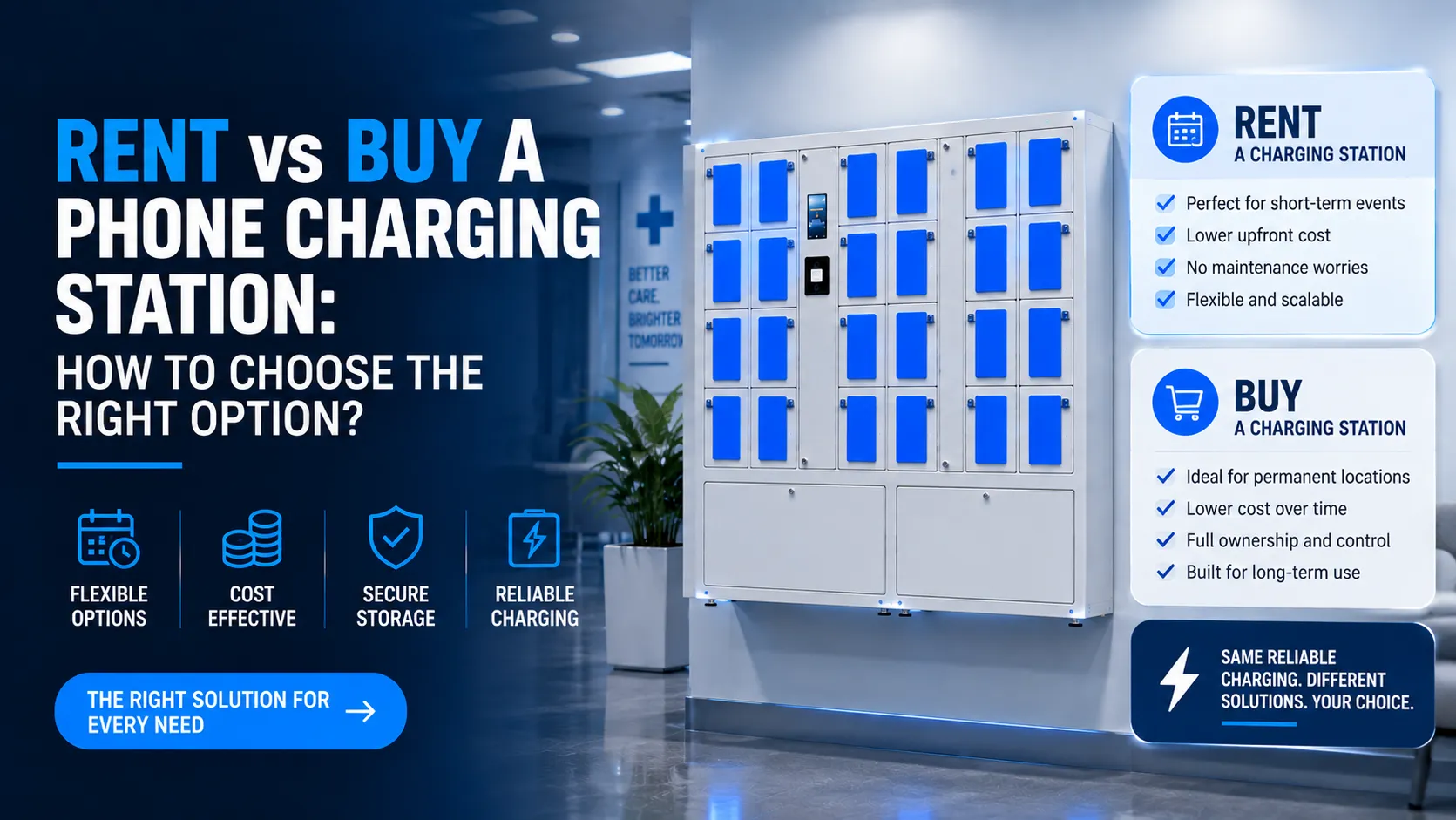
The answer of Rent vs Buy a Phone Charging Station depends on how often you need it. If you’re running a two day trade show or a weekend music festival, renting a cell phone charging station saves money and eliminates logistics headaches. If you operate a hospital lobby, college campus, or corporate office where devices need power 365 days a year, buying is the cheaper path over time.
Should You Rent or Buy a Phone Charging Station?
- Rent when the need is temporary: trade shows, conferences, seasonal activations, or a one-off event where you need phone charging solutions fast.
- Buy when the need is permanent: hospitals, universities, shopping malls, airports, and corporate offices with daily foot traffic and ongoing cell phone charging demand.
HonestWaves offers both phone charging station rentals and outright purchases, so the guidance here is based on your actual situation, not a push toward one business model. The rest of this article breaks down cost, logistics, the rental or buying process, branding options, and real scenarios to help you decide. You’ll encounter terms like charging lockers (secure bays with PIN access), charging tables (built-in cables and wireless pads), and phone charging kiosk (battery bank dispensers for events).
How Phone Charging Stations Work and Where They’re Used?
A modern phone charging station falls into one of four categories in today’s market. Secure phone charging lockers let users lock their device behind a PIN or RFID code while it charges. Charging tables embed multiple charging cables and wireless pads into a counter surface for open-access use in lobbies and coffee shops. Tabletop charging stations are space-efficient units stocked with portable power banks. And a portable cell phone charging kiosk dispenses power bank units that attendees carry and return later.
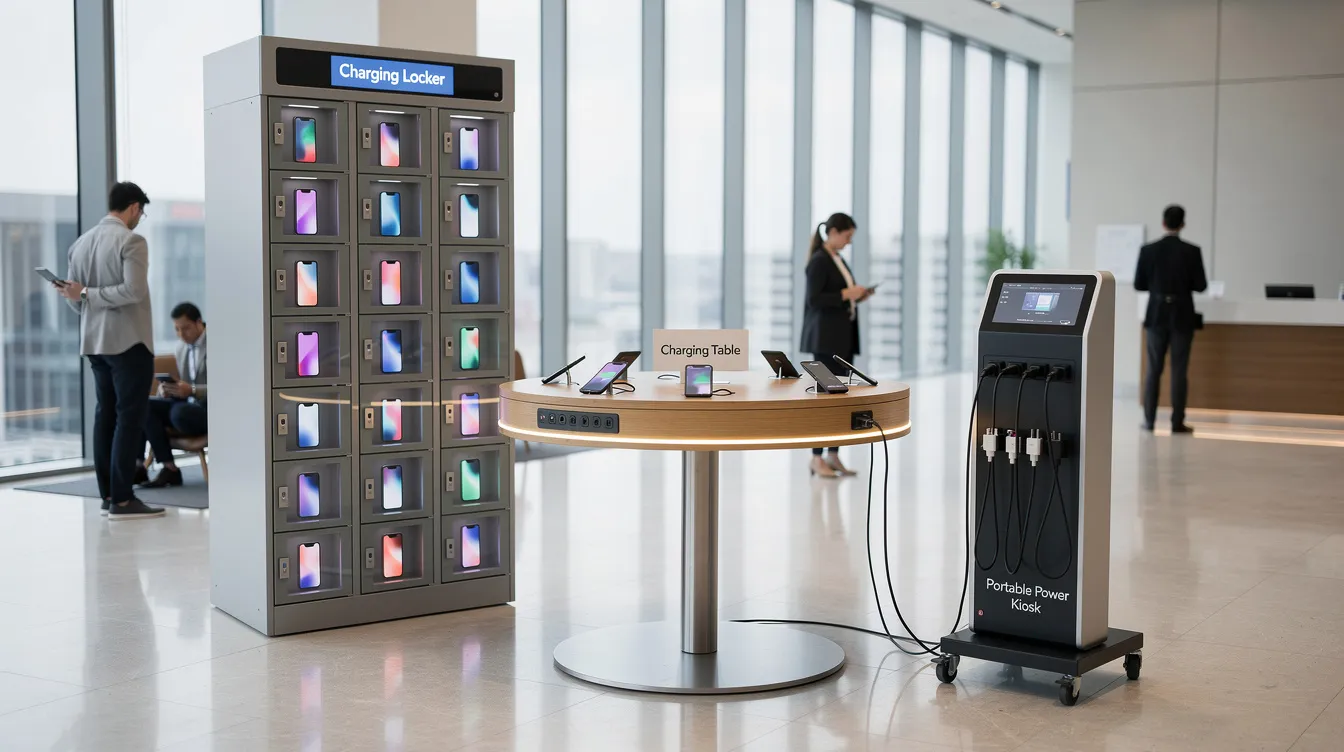
These stations show up in airports, ER waiting rooms, convention centers hosting 3-day trade shows in Las Vegas, outdoor festivals, and large retail stores. Charging stations can be wall-mounted or stand-alone depending on the setting. Key features to look for: data blocking technology (which prevents unauthorized data access through USB ports), fast charging via USB-C PD, cloud connectivity for usage analytics, durable construction to withstand frequent use in high-traffic areas, and a reputable brand for durability and reliability.
Cost Comparison: Renting vs Buying a Charging Station
Cost is usually the first question, and the right framing is total cost of ownership, not sticker price.
Rental pricing for phone charging stations typically runs $400 to $500 per day per unit for tables or lockers. Multi-day events get volume discounts; a kiosk with 24-96 battery packs rents for roughly $900 to $1,310 for a 3-5 day event. Branding wraps add $250 to $400 per unit. Renting avoids hefty upfront costs and saves on initial purchase costs.
Purchase pricing varies by type. High-quality commercial-grade charging kiosks can cost from $500 to $5,000. Industry data shows the per-door cost for charging lockers runs $25 to $60 per compartment, with complete 8-bay units starting around $1,500 and 28-bay smart systems exceeding $5,000. Adding charging capability increases a locker’s base price by 25-40%.
A break-even analysis helps determine the right path by weighing long-term value, not just raw cost. If you purchase a $3,000 unit, add $500/year in maintenance, and use it 200 days annually over four years, your cost per day drops to about $6.25. Compare that to $500/day rentals and the math is clear for permanent locations. Cumulative rental fees generally exceed the purchase price over several years. Taxes and ownership responsibilities also vary between renting and buying; rental payments are often fully deductible as operating expenses.
When Renting Phone Charging Stations Makes More Sense?
Renting is ideal for short-term events where temporary needs and short-term activations are the priority. Flexibility for scaling the number of units is greater with rentals, and you get immediate access to phone charging solutions without waiting for procurement cycles.
Concrete scenarios where renting wins, especially when organizers already have a clear idea of placement and unit count:
- A 2-day trade show in Orlando needing branded charging lockers at your booth
- A 4-day outdoor music festival requiring weather-resistant portable kiosks
- A product roadshow hitting four cities in two weeks, where renting allows easy relocation of charging stations between stops
- A once-a-year corporate summit where the venue changes annually
Rental stations can adapt to seasonal trends and events. Maintenance concerns are lower when you rent phone charging stations because the rental company handles maintenance and updates. Deployment logistics are easier; stations can be set up quickly with plug-and-play functionality, and renting typically includes vendor-provided technical support.
Renting charging stations can increase foot traffic by nearly 35%, which makes them a cost effective marketing strategy for events where attendee satisfaction and dwell time drive revenue. Charging stations enhance customer experience, improve the overall experience, and keep guests connected, reducing low battery anxiety and the desperate state of a drained cell phone battery.
Custom branding is available on rental units, though customization of branding is limited compared to owned hardware. Expect to submit artwork about 15 business days before your event to avoid rush fees. Event organizers often offset rental cost by selling charging station branding to sponsors as premium visibility, turning the station into a cost effective added service.
When Buying a Phone Charging Station Is the Better Long-Term Play?
Purchasing makes sense for permanent installations in public spaces where the unit runs daily. Owning a charging station may yield a lower long-term cost because buying avoids ongoing rental fees, resulting in a lower per-use cost over time.
Where buying wins:
- Hospitals needing secure charging in waiting areas year-round, with UV-C disinfection and data-blocking as standard
- Universities installing stations across a college campus for students and staff
- Corporate headquarters placing charging tables in lobbies and collaboration spaces
- Transit hubs where commuters expect constant access to power
Owning a unit allows for full customization and control over configuration, uptime, and branding options. Buying provides an asset that can be resold or repurposed later if spaces change. Ownership also allows for potential revenue generation through sponsorship placements or by charging users an hourly rate.
The trade-offs: purchasing shifts the responsibility of repairs onto the owner, and buying can lead to risk of obsolescence if technology changes. Public charging stations can also pose theft risks for devices, making secure lockers with PIN access a better investment than open docks for high-traffic areas.
Key Factors to Evaluate Before You Decide
Use this checklist to frame your rent vs buy decision, including shifts in consumer behavior:
Traffic and dwell time. A busy shopping mall with 10,000 daily visitors justifies purchasing multiple units. A 300-person local event does not. Higher traffic means faster payback on purchased hardware.
Frequency and duration. One-off events favor renting. Recurring quarterly events might justify buying one “house” unit for the venue and renting extra capacity during peak periods. Continuous daily operations almost always favor purchase.
Budget structure. Many US organisations distinguish between OPEX (operating budgets where rentals live) and CAPEX (capital budgets for purchases). Flexible rental terms fit event budgets; capital purchases fit facilities budgets.
Branding and sponsorship. Long-term installations justify permanent custom branding. For events, sponsor-funded branding on rental units offsets cost and adds a valuable service to your sponsorship packages.
Security and compliance. Hospitals, schools, and government offices need secure lockers with data-blocking and compliance sign-off, which favors buying vetted, standardized units from a single vendor.
Support and maintenance. Rental contracts bundle maintenance. Purchased hardware relies on warranties, so evaluate the provider company behind that coverage and support; Honestwaves covers this with a lifetime hardware warranty and cloud-based diagnostics.
Space and installation. Measure available space, confirm power outlet locations, and consider ADA accessibility. Wall-mounted units save floor space; free-standing towers accommodate higher volume.
Honestwaves Solutions: Rental vs Purchase Options
Honestwaves is a USA-based B2B provider of phone charging stations, smart lockers, and portable kiosks serving hospitals, schools, venues, and events.
Rental offerings include charging lockers, portable battery pack kiosks, and charging tables with flexible rental terms from 1-2 days up to multi-week deployments. Every rental includes pre-configuration, shipping, plug-and-play setup, and optional remote monitoring.
Purchase offerings include permanent smart locker installations with PIN or RFID access, UV-C disinfection, data-blocking USB, and cloud-connected analytics dashboards. Units ship with a lifetime hardware warranty and US-based support.
Custom branding covers full vinyl wraps, on-screen messaging, sponsor logos, and branded power banks for both rentals and purchases.
Ready to compare? Request a tailored quote with side-by-side pricing for your exact visitor counts, event dates, or facility size.
FAQs
Is it cheaper to rent or buy a phone charging station for my use case?
For a single 2-3 day event, renting is almost always cheaper. A rental might run $900 to $1,600 for the event; purchasing the same unit costs $1,500 to $5,000 before installation. For permanent locations used daily, buying becomes cheaper within 12-24 months because the hardware cost spreads across hundreds of days of use. Estimate your annual usage days, multiply by expected lifespan (3-5 years), and compare that total to recurring rental fees.
How many phone charging stations do I actually need?
A useful rule of thumb: one 8-10 bay locker per 150-250 simultaneous visitors in a lobby or waiting area. A full-day music festival with 20,000 attendees needs distributed charging stations or portable battery kiosks spread across the grounds. A 500-person conference typically needs 1-2 locker units plus a charging table. Start conservative with permanent installs and use usage analytics to inform expansion.
Are phone charging stations secure and safe for users’ data?
Professionally built stations include data blocking technology on USB ports, allowing only power to flow and preventing data transfer. Secure lockers with PIN access prevent theft and tampering. Avoid unverified DIY charging hubs or “mystery” cables in public venues. The FBI has warned consumers about “juice jacking” risks at unprotected public USB ports, which is why data-blocking is a baseline feature on Honestwaves hardware.
What’s the difference between renting, leasing, and buying a charging station?
Renting means short-term use (days or weeks) where hardware is returned after the event. Leasing is a medium-to-long-term financing arrangement (typically 24-60 months) with monthly payments; you keep the unit on-site but may not own it until the term ends. Buying is a one-time capital purchase with full ownership and full responsibility for maintenance. Honestwaves supports all three models, though most clients fall into the rent or buy category.
Can I add custom branding to rented phone charging stations?
Yes. Most rental stations accept custom vinyl wraps, screen graphics, looping sponsor videos, and branded power banks. Plan to submit final artwork 2-3 weeks before your event. Event organizers regularly sell charging station sponsorship to offset rental costs; the kiosk screen becomes a high-visibility ad placement that keeps attendees engaged while their devices charge.
How do I measure the ROI of a phone charging station?
Track these metrics: number of unique users or locker sessions per day, average session time, conversions from on-screen QR codes, and repeat visits. According to industry research, attendees report battery anxiety at around 38% battery level, and providing a charging relief factor directly increases dwell time and spend. Honestwaves’ cloud-connected stations generate usage analytics dashboards, giving your sales team and stakeholders concrete data to justify the investment.