
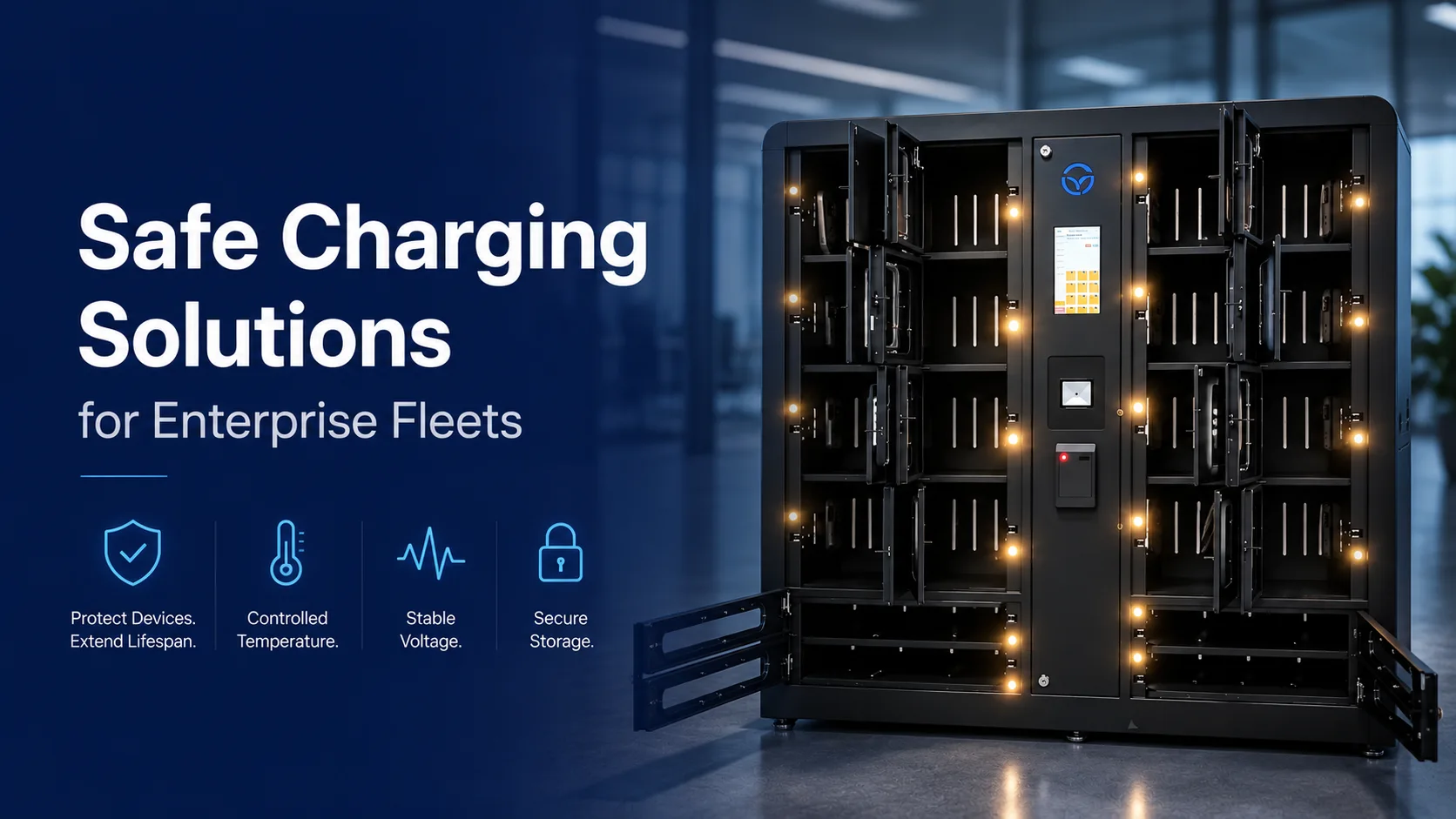
Plug $20,000 worth of company tablets into a $40 multi-port charger, and you’ll be replacing batteries in under 9 months due to micro-voltage fluctuations and trapped heat.
That’s the part most procurement sheets skip. Safe charging solutions are not about “more watts.” They are about controlled temperature, stable voltage, secure storage, and protocol-aware smart charging across multiple devices.
Safe charging solutions in the real world: answer-first overview
Safe charging refers to the process of delivering power to electronic devices in a way that protects batteries, helps prevent overheating, and supports stable energy distribution. For IT Directors, SysAdmins, and Operations Managers, the real problem is not charging speed. It is fast charging battery degradation, swollen packs, downtime, and facility risk.
In 2023–2025 device rollouts, we repeatedly saw the same setup fail: consumer-grade fast chargers, crowded cabinets, cheap cables, and no thermal control. The result was predictable: random shutdowns, reduced capacity, helpdesk tickets, and devices quarantined after pack swelling.
A well-designed charging system considers the limits of the power source, the needs of the devices, and the conditions of the charging environment to reduce risk when multiple devices charge simultaneously.
HonestWaves builds secure charging station infrastructure for hospitals, schools, offices, event venues, and enterprise fleets. That includes phone charging stations, enterprise tablet lockers, charging tables, portable kiosks, RFID/PIN access, data blocking, UV-C disinfection, rentals, and custom configuration support.
This article explains the chemistry, the heat, the voltage regulation, and the UL-grade safety requirements that separate engineered equipment from a cabinet full of outlets.
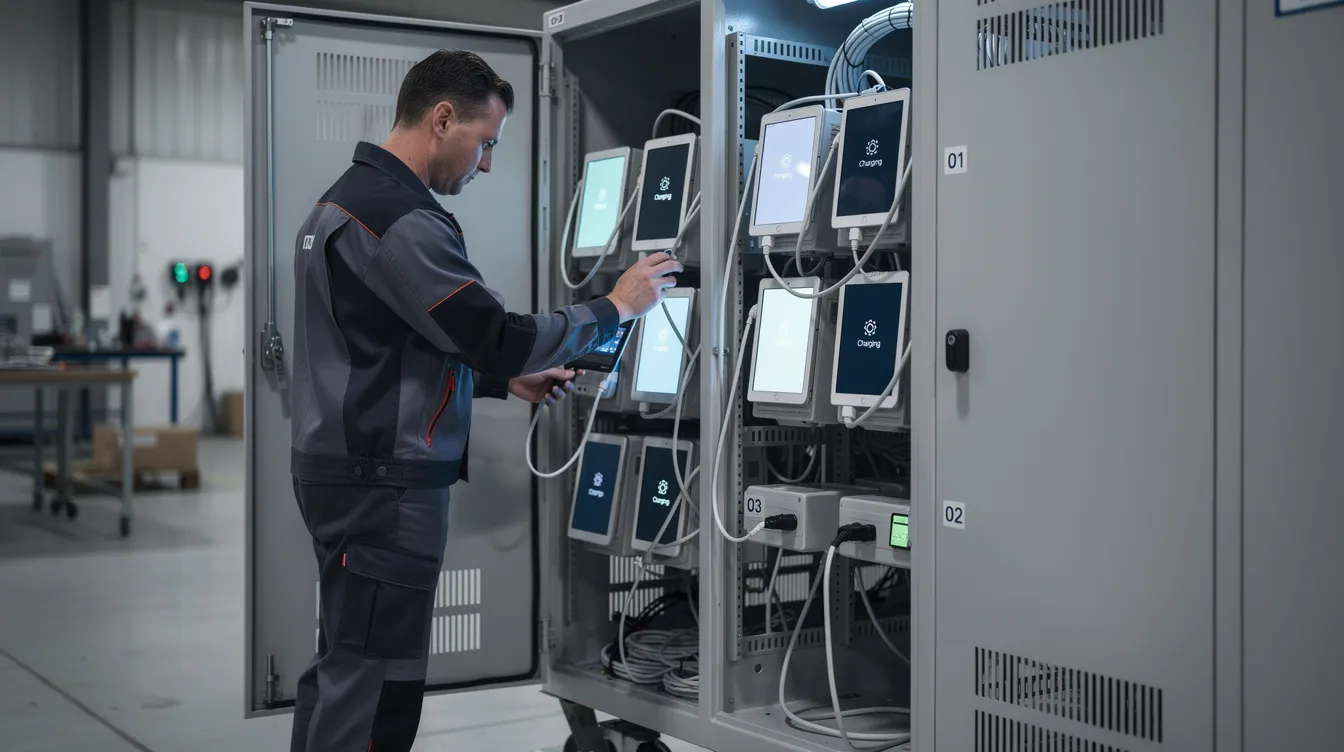
TL;DR: why Intelligent Power Management triples fleet battery life
Intelligent Power Management, or IPM, is the difference between guessing and control. It actively manages charger behavior, current flow, bay temperature, and devices charged instead of letting every adapter fight for power.
- Unmanaged multi-port USB strips commonly push usable battery life down to 18–24 months; IPM-equipped lockers typically support 36–48 months before capacity becomes operationally limiting.
- IPM keeps charging environments near 35°C / 95°F or below, while best practice is to charge devices in spaces between 60°F and 80°F to prevent thermal stress.
- IPM clamps cell voltage around 4.15–4.20 V instead of hard-floating batteries above safe limits.
- HonestWaves’ Eco Safe Charge technology is designed to intelligently distribute power among multiple devices, reducing the risk of overheating and ensuring a more controlled charging environment.
- HonestWaves’ IPM boards dynamically allocate current per bay, enforce auto-shutoff at full charge, and log per-slot charging analytics for IT teams.
- In real world pilots, a 120-tablet logistics warehouse deployment over 24 months showed a 2–3× lower battery replacement rate versus legacy carts.
Using safe charging solutions prevents irreversible battery damage and eliminates severe fire hazards caused by overheating or short circuits. Implementing safe charging solutions protects devices from battery degradation and eliminates fire hazards.
The heat trap: what happens inside a closed locker when 10 tablets charge at once?
Ten tablets at 30–45 W each in a sealed steel locker can push internal air above 40°C / 104°F. Without ventilation and IPM, heat accumulates faster than the cabinet can reject it, accelerating lithium-ion aging and increasing thermal runaway risk.
During high power fast charging, each tablet may dissipate 10–15 W as heat. In a 0.1–0.2 m³ storage compartment with low airflow, that can create a temperature rise above 10°C in under 30 minutes.
That matters because lithium-ion batteries are chemical systems, not simple fuel tanks. Above about 35°C / 95°F, the solid electrolyte interphase, or SEI layer, grows faster. Internal resistance rises, capacity fades, and calendar aging can roughly double for every 10°C increase.
A school cart or hospital cabinet often makes this worse. Devices are stacked tightly, vents are blocked, charging bricks have no clearance, and fans are omitted to save cost. Proper ventilation clearance of at least two inches around charging bricks is essential for safety.
Charging devices on hard surfaces prevents heat trapping and reduces fire hazards. A tablet left charging on fabric, foam, or a cluttered shelf behaves very differently from a tablet in a ventilated bay.
HonestWaves enterprise tablet lockers are built around the heat problem: perforated door patterns, forced-air flow paths, per-bay temperature sensing, and firmware that can throttle or shut charging down if a bay exceeds safe thresholds.
Lithium-ion physics: why unstable voltage and cheap hubs destroy enterprise batteries
Lithium-ion cells are optimized for a narrow operating window: roughly 3.0–4.2 V per cell and moderate temperature. Poor voltage regulation, noisy ripple, and cheap hubs push cells outside that window, which can lead to gas generation, capacity loss, swelling, and rare but serious thermal runaway events.
The physics is straightforward. A low-quality multi-port hub may sag under load, overshoot during negotiation, or create ripple across shared rails. Those micro-voltage fluctuations stress anode and cathode structures.
Two failure mechanisms dominate.
- SEI layer growth from sustained high voltage and heat consumes active lithium.
- Lithium plating at low temperatures or high C-rates can form dendrites that create long term short-circuit risk.
Fast charging is not automatically destructive. The problem is uncontrolled fast charging combined with poor thermal design, cheap cables, and non-compliant USB-C behavior. Safe fast charging relies on several key factors, including voltage regulation, heat control, and communication between the charger and the device, ensuring that the battery receives only as much power as it can safely handle.
Modern fast charging systems utilize smart chips that control voltage and current flow in real time, helping to manage heat and protect the battery during charging. Gallium nitride, or GaN, technology is increasingly used in chargers, as it allows for smaller, cooler, and more efficient charging solutions compared to traditional silicon components. High-output desktop hubs utilizing GaN technology can run cooler and more efficiently, but they still need proper cable quality, surge protection, and thermal spacing.
Only purchase chargers and cables from reputable brands or original device manufacturers to avoid counterfeits that lack necessary safety fuses. Using uncertified chargers can damage a device’s battery, shorten its lifespan, or cause dangerous electrical fires.
For technical background, recent lithium-ion float-charge research shows how high voltage and elevated temperature accelerate capacity fade and SEI resistance growth in NMC/graphite cells (Journal of Power Sources via ScienceDirect).
How Intelligent Power Management (IPM) differs from standard USB ports
Standard passive hubs divide available current and hope the connected devices behave. IPM-based smart charging systems negotiate per-device power profiles, monitor temperature and state-of-charge, and enforce safe power envelopes for each port. That is the difference between a commodity charger and enterprise infrastructure.
Smart charging systems utilize protocols like USB Power Delivery (PD) and Programmable Power Supply (PPS) to manage power distribution effectively, ensuring devices receive only the power they can safely handle.
An IPM board can negotiate 5 V, 9 V, 12 V, 15 V, or 20 V depending on device class. It can also adjust current as pack impedance changes, rather than dumping maximum current into every device.
Chargers that feature dedicated “trickle” or “care mode” help optimize battery health by avoiding continuous charging after a device is fully charged. In enterprise lockers, the better version is auto-shutoff: when a device reaches 100% or a configured 80–90% threshold, the system stops bulk charging and drops into maintenance.
Good IPM also includes surge protection and line conditioning. MOVs, TVS diodes, and filtered DC-DC stages reduce ripple and spikes from building power before they reach devices. Using high-quality power strips with a Joules rating above 1,000 helps prevent voltage spikes, but a true enterprise solution should integrate protection at the system level.
High-quality chargers feature built-in safeguards, like overcurrent and temperature protection, to prevent overheating. Certified chargers regulate voltage to prevent overheating and melting, protecting devices from fires.
HonestWaves’ cloud-connected IPM in lockers and charging tables logs per-port power draw, flags abnormal charge curves, and lets IT tune profiles for scanners, tablets, phones, laptops, or mixed-device rooms.
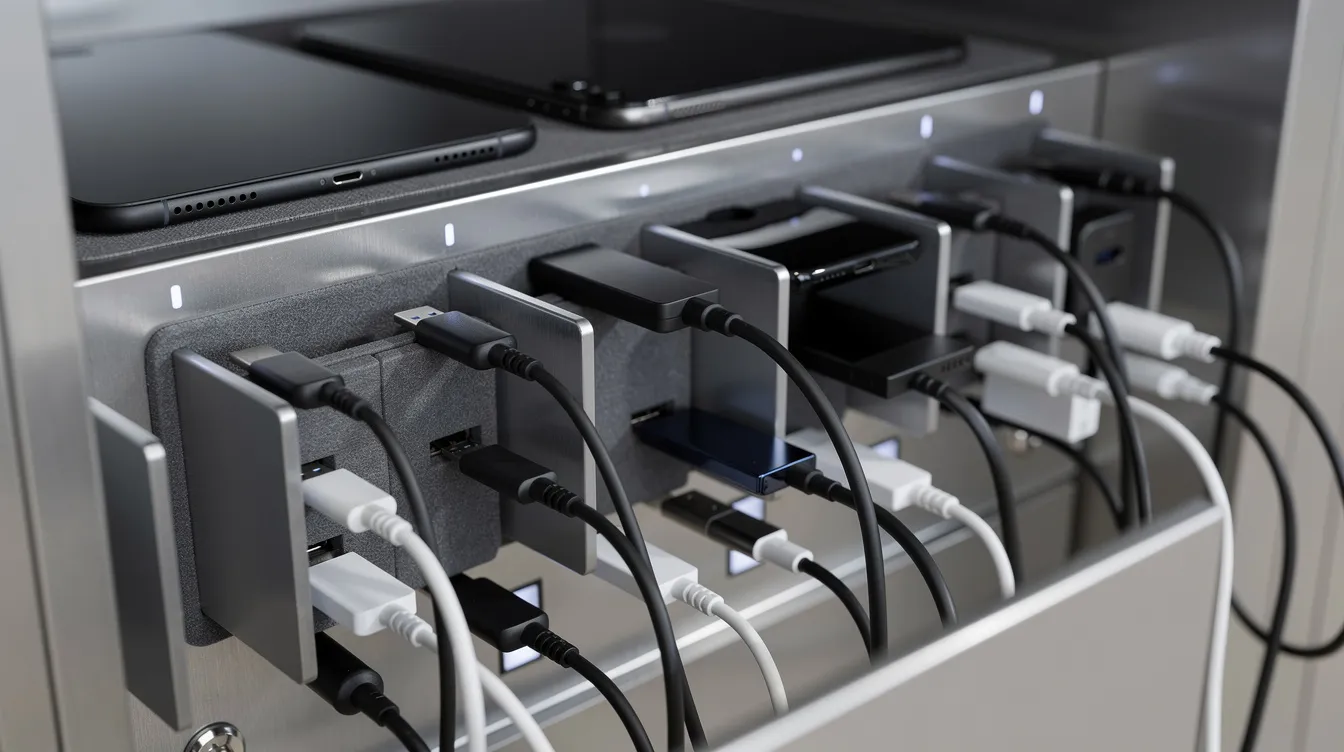
Safe charging for multiple devices: designing scalable station infrastructure
Safe multi-device charging scales only when power distribution, cabling, airflow, branch-circuit limits, and mechanical layout are engineered as one system. A pile of adapters plugged into a wall strip is not a scalable setup for classrooms, hospitals, events, or shared office fleets.
Charging multiple devices simultaneously without proper management can lead to uneven charging speeds and increased heat, which can stress batteries and reduce their lifespan. Charging multiple devices can be safe when power is managed properly, heat is controlled, and the charging solution matches the needs of the connected devices.
A typical enterprise station might support 20–40 tablets at 30 W each, plus 10–20 phones, scanners, accessories, and sometimes laptops. On a 15 A circuit, that requires load shedding and stage-based charging, not every bay pulling peak power at once.
Safe charging technologies manage current flow, device demand, and charging priorities to reduce risk in shared environments such as classrooms and IT deployments. Charging systems that support smart power distribution help protect devices, support energy efficiency, and make large-scale charging more dependable for organizations.
Cable management is not cosmetic. Short, certified USB-C or Lightning cables with strain relief reduce connector fatigue, intermittent faults, and support tickets that look like battery issues. One bad cable can make a reliable tablet appear defective.
HonestWaves designs safe charging solutions as modular systems: portable kiosks for event portability, wall stations for public spaces, charging tables for office collaboration, and lockers for secure storage. The same IPM and safety stack can be used across a facility, reducing friction for IT support.
Centralized charging solutions are essential in environments like schools and hospitals to enhance productivity and reduce downtime for devices. Secure storage solutions for devices, such as smart lockers and charging stations, enhance productivity and reduce downtime in various environments including schools and hospitals.
Ensuring UL compliance: the safety features your charging infrastructure must have
UL compliance is non-negotiable for B2B charging infrastructure, especially where visitors, patients, students, or employees interact with hardware daily. “Tested to” is not the same as documented listing, and procurement teams should not forget that distinction during purchase reviews.
Relevant standards include UL 62368-1 for audio/video and ICT equipment, UL 60950-1 for legacy IT equipment references, UL 2361 for custom kiosks, and UL 8802 for UV germicidal equipment. Depending on the exact configuration, UL 2595 or UL 60884 references may also apply to charging assemblies, plug interfaces, or outlets. UL describes UL 8802 as a standard for ultraviolet germicidal products with containment and human-exposure safeguards (UL).
The required safeguards are practical:
| Safety feature | Why it matters |
|---|---|
| Auto-thermal shutoff sensors | NTC or digital sensors per bay throttle or disconnect charging during overheating |
| FR-rated circuit boards | Proper creepage, clearance, and insulation reduce arcing and fire risk |
| Certified AC inlets and fusing | Protects the facility circuit and downstream electronics |
| Data-blocking USB technology | Prevents juice-jacking and unauthorized data access |
| UV-C smart boards | Control sanitizing cycles, interlocks, and exposure limits |
Data blocking is essential in public-facing stations. HonestWaves power-only ports remove or isolate USB data lines, while managed enterprise bays can use authenticated secure data paths where required by IT policy.
UV-C sanitizing is increasingly requested in healthcare and education. In a safe design, UV-C is enclosed, timed, interlocked, and controlled so it disinfects device surfaces without creating exposure risk for users or unnecessary stress on plastics and batteries.
Enterprise tablet lockers: long term reliability, analytics, and operations
Enterprise tablet lockers have evolved from metal boxes with outlets into networked assets that secure devices, manage charging intelligently, and feed telemetry back to IT. The operational benefit is simple: fewer missing devices, fewer dead batteries, and better lifecycle planning.
Access control matters. RFID, PIN access, audit logs, tamper-evident construction, and optional identity integrations help IT manage who removed which device and when. Charging solutions that incorporate secure storage can significantly reduce the risk of theft or damage to devices, particularly in high-traffic areas like event venues.
Analytics change the maintenance model. Dashboards can show charge cycles, overnight charging duration, time above 80% SoC, thermal events, non-returned devices, and abnormal charging curves. That gives IT data instead of anecdotes.
Fast charging battery degradation is often a workflow issue. A shared tablet may run from 100% to near-zero during a shift, then get slammed back to 100% twice per day, 365 days per year. Lockers can enforce 80–90% limits where operationally acceptable, protecting battery life without asking users to manage it manually.
Secure charging stations in healthcare settings improve communication and satisfaction among patients and staff by ensuring devices are always powered. Charging stations designed for educational institutions help promote digital equity and streamline classroom management by providing reliable power access for student devices.
Durable and secure storage for devices promotes digital equity and streamlined management in educational settings, ensuring devices are readily available for use. In a 2024 hospital deployment of 300 tablets using HonestWaves lockers, the facility saw reduced loss and theft, higher readiness at shift start, and fewer battery-related helpdesk tickets than with previous unmanaged carts.

Why HonestWaves’ secure charging technology is a safer
Generic strips, passive hubs, and consumer adapters are misaligned with enterprise risk. HonestWaves’ Secure Charging Technology is built for long term reliability, safer power delivery, controlled storage, and operational visibility across real facilities.
That includes secure phone charging stations, UV-C enabled enterprise tablet lockers, portable kiosks, charging tables, cabinet systems, rentals, and custom hardware for schools, hospitals, offices, venues, and government environments. It also includes cloud monitoring, data blocking, RFID/PIN access, and large-order support.
Need a rental for a one-week event? Need a wall-mounted station for public phones? Need a 40-bay locker for tablets and scanners? Need to install a permanent setup across classrooms or a hospital wing? The same engineering principles apply: stable voltage, managed heat, secure access, and dependable reporting.
Here’s the bottom line: you can skip the engineering upfront, but you will pay for it later in battery replacements, downtime, swollen packs, security gaps, and emergency equipment reviews.
Don’t compromise your corporate mobile hardware reliability. Contact HonestWaves today to review custom safe charging specs for your environment or to get a detailed project quote.