
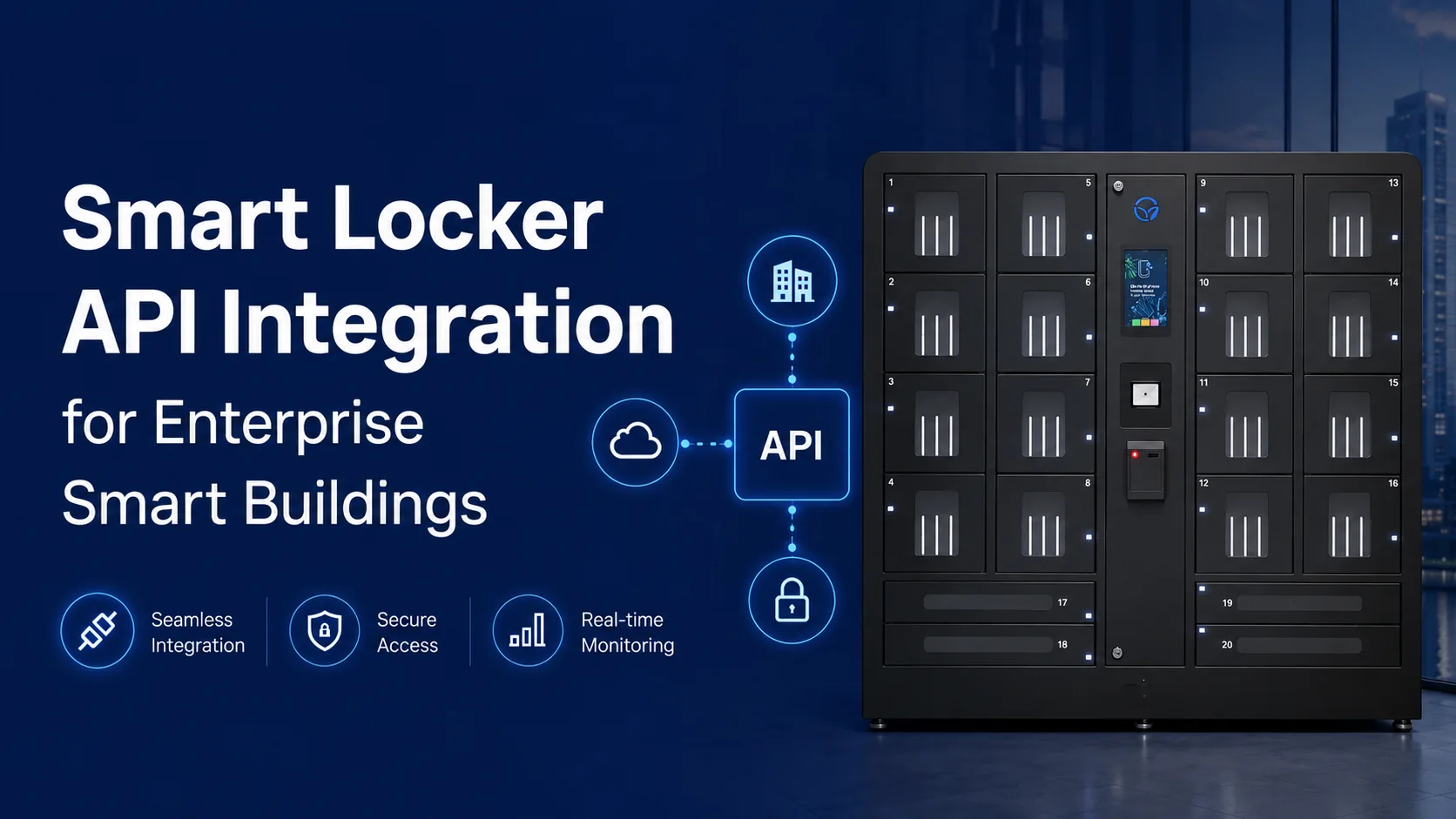
If your physical smart lockers cannot automatically sync with your HR database, de-provisioning an employee when they leave or onboarding them on day one, you are not running a smart facility. You are just running automated cabinets.
For CIOs, IT directors, enterprise security architects, and system administrators, smart locker API integration is now part of the software stack behind smart buildings. HonestWaves smart lockers, phone charging stations, and portable charging kiosks should be treated as connected IoT nodes that integrate with identity, access control, building automation systems, and remote management systems.
Smart locker API integration in modern smart buildings
Smart locker API integration means HR, IAM, access control, device telemetry, and building automation systems stay synchronized in near real time. In modern smart building systems, lockers are not isolated physical hardware; they are policy-driven endpoints connected to identity providers, cloud dashboards, webhooks, and facility automation systems.
Imagine a 10,000-employee campus in 2026. Without integration, service desks manually assign lockers, recover keys, reset PINs, handle lost badges, and reconcile device returns. Operational efficiency is improved by reducing manual handling and mitigating wait times at service desks, freeing up staff for higher-value tasks.
With full smart locker API integration, a new hire appears in Workday, gets provisioned through active directory or Okta, receives badge-based access to a designated locker neighborhood, and can use a secure charging bay on day one. When employment ends, the same identity workflow removes access, closes sessions, and prevents unreturned assets.
In this article, we will cover REST APIs, SSO, active directory lockers, smart building technology, cloud remote management, webhook alerts, and secure architecture patterns for commercial buildings. The perspective is that of an enterprise software architect and smart building systems engineer designing for CIOs, IT directors, and sysadmins.
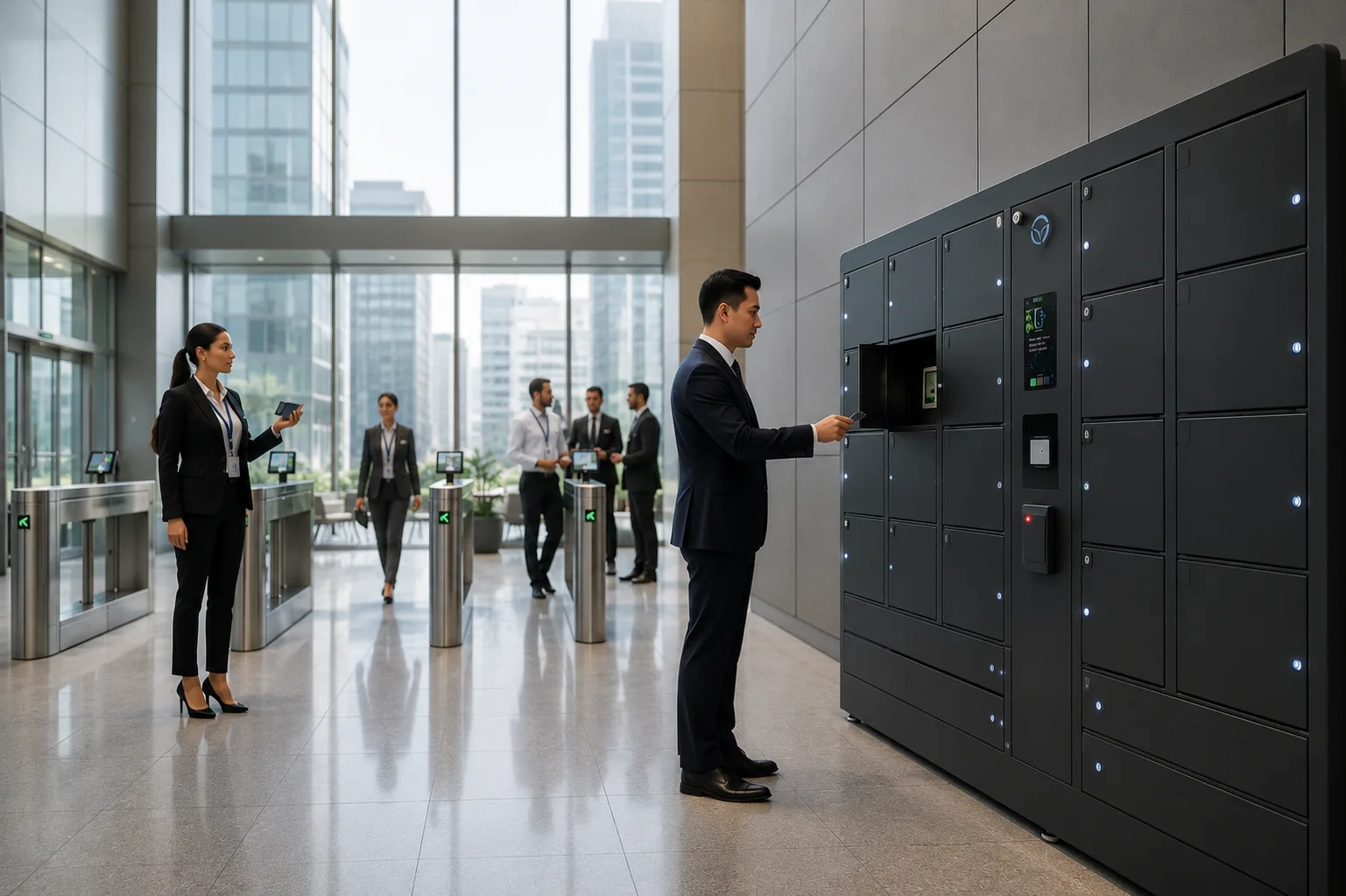
Key takeaways for CIOs and enterprise IT teams
Smart locker systems deliver the most value when they integrate with identity, facility, and IT service management platforms. The following metrics are typical planning ranges based on analogous smart building technologies, occupancy systems, and enterprise IoT deployments.
- Automated provisioning can reduce manual IT tickets for device handoff, lost keys, PIN resets, and access failures by 40–60%.
- Same-minute de-provisioning when users are disabled in Active Directory, Entra ID, Okta, or HRIS can reduce unauthorized locker access risk by more than 80%.
- Smart buildings increase energy efficiency by optimizing heating, lighting, and air quality control, which helps reduce costs and waste, contributing to sustainability goals.
- Locker occupancy data can improve locker utilization, support energy use optimization, and help building managers make informed decisions across commercial buildings.
- Audit logs provide powerful analytics: user, bay, timestamp, delivery status, failed badge attempts, and recovery information for investigations.
- Lockers that are managed remotely enable centralized policies, group policy-like templates, lower on-site support load, and reduced manual labor for multi-campus organizations.
Connecting hardware to software: The role of open REST APIs in smart building designs
HonestWaves smart lockers expose RESTful endpoints for state, commands, and event data, secured with OAuth 2.0 and encrypted transport. This API layer allows smart lockers to push occupancy, power, and door data to cloud dashboards while receiving dynamic commands from booking systems, facilities apps, and automation systems.
A connected charging locker typically contains:
- Edge controller running embedded firmware
- RFID, PIN, qr code, or badge reader module
- Door state, bay occupancy, tamper, and power sensors
- USB charging controllers with data blocking technology
- Encrypted local storage for device identity and tokens
- Ethernet, Wi-Fi, or cellular connectivity using TLS 1.2+ or TLS 1.3
Many smart lockers are equipped with cloud connectivity, allowing for remote management and monitoring of usage data, which can help optimize operations. Smart lockers can utilize cloud-based systems for data management, enabling remote access and control, which is essential for modern facility management.
A basic state call might look like this:
GET /api/v1/lockers/LW-05-Floor3-BankA/state
Authorization: Bearer <access_token>
Accept: application/json
{
  "locker_id": "LW-05-Floor3-BankA",
  "building_id": "Campus1-BuildingA",
  "zones": [
    {
      "bay_id": "Bay03",
      "occupied": true,
      "door_state": "closed",
      "power_usage_watt": 12.8
    }
  ],
  "last_update": "2026-05-30T10:23:45Z"
}
A command should be idempotent, especially when connectivity is unstable:
POST /api/v1/lockers/LW-05-Floor3-BankA/commands/lock
Authorization: Bearer <access_token>
Idempotency-Key: 1a5c9dd6-1f41-4f3a-8f0b-0a2f1d1a9210
Content-Type: application/json
{
  "bay_id": "Bay03",
  "command": "lock",
  "reason": "meeting-ended-callback"
}
Two-way APIs are what turn smart locker systems into intelligent systems. The locker cloud can push telemetry such as occupancy sensors, door state, battery status, delivery status, charger health, and power draw into building management systems. The same APIs can receive commands from booking systems, access control platforms, and facility scheduling tools.
For example, when a conference room is booked, a facilities application can automatically reserve nearby charging lockers. When the meeting ends, a callback releases those bays and updates locker utilization data.
Authentication should use OAuth 2.0 client credentials for machine-to-machine integration. Tokens should be short-lived, scoped by building or device group, and limited to permissions such as locker:read, locker:write, telemetry:read, or command:execute.
For smart building design, REST APIs often need a bridge into BAS protocols. A BACnet/IP gateway or MQTT bridge can translate locker telemetry into objects consumed by hvac systems, smart lighting solutions, air conditioning controls, and air quality sensors.
Automated systems in smart buildings can control lighting and HVAC systems to reduce energy waste when spaces are unoccupied, leading to lower operational costs. PointGrab reports that occupancy-driven BMS integrations can support 15–30% HVAC energy savings, depending on deployment conditions.
HonestWaves API environments should support production and sandbox endpoints, versioned APIs, rate limits, and CI/CD contract testing. Regular updates and maintenance are needed for APIs to stay synced with hardware and to troubleshoot connectivity or mechanical issues.
SSO & Active Directory: Automatically provisioning locker access control rights via security badges
Active Directory, Azure AD or Entra ID, Okta, and other IdPs can act as the single source of truth for locker entitlements. With SSO, LDAP, SCIM, SAML, OIDC, and role-based access control, active directory lockers become enterprise resources governed by identity lifecycle rules rather than manually assigned cabinets.
The “active directory lockers” model treats each locker bank, zone, or bay as a secured resource. Access can be mapped to users through group membership, department, location, organizational unit, badge ID, or device checkout role.
A common workflow looks like this:
- HRIS creates a new employee record.
- IdM assigns the employee to an active directory group.
- Domain controllers replicate the group membership through active directory domain services.
- HonestWaves receives a SCIM, Graph, or webhook event.
- The locker service assigns default access to the user’s building zone.
This makes onboarding an automated process instead of a service desk queue. Automation eliminates manual logging and allows systems to assign lockers automatically and track package status instantly.
Smart lockers often feature RFID or PIN access systems, enhancing security by ensuring that only authorized users can access the contents. Badge-based SSO maps a card number or UID to a directory identity, then validates access against policy through SAML, OIDC, or a cached offline entitlement.
De-provisioning is more important than onboarding. When HR terminates a user, the account can be disabled, moved to a disabled organizational unit, or removed from groups. The locker service should revoke access, invalidate sessions, and release any allocated bay within seconds or minutes.
A policy object can be synchronized from the directory:
{
  "user_id": "abc123",
  "user_principal_name": "jdoe@enterprise.com",
  "groups": ["engineering", "device_checkout"],
  "valid_from": "2026-05-01T08:00:00Z",
  "valid_to": "2027-05-01T17:00:00Z",
  "door_list": [
    "Bldg1-5thEast-Bay01",
    "Bldg1-5thEast-Bay02"
  ],
  "business_hours": {
    "start": "08:00",
    "end": "18:00",
    "days": ["Mon", "Tue", "Wed", "Thu", "Fri"]
  },
  "emergency_override": {
    "enabled": true,
    "admin_groups": ["facilities_admin"],
    "recovery_keys_required": true
  }
}
IT teams can manage locker rules in a style similar to group policy. Maximum checkout duration, business-hours access, emergency access, guest rules, and admin recovery password rotation can be controlled centrally.
The Windows analogy is useful. If your team already uses group policy management to store bitlocker recovery information in ad ds, the locker model is similar: policy, identity, and recovery information are automatically stored for auditability. Bitlocker drive encryption protects an os drive; locker access policy protects a physical bay. In both cases, save keys, enforce key backup, and control who can view bitlocker recovery information or locker recovery keys.
Combined identity logs and locker logs create a defensible audit trail: who accessed which bay, when, from which building, and under what policy. That recovery information is critical for incident response, compliance, and asset investigations.
Automated webhooks: Real-time alerts for left-open doors, tampering, and SLA breaches
Polling every five minutes is not enough for physical security, SLA enforcement, or ITSM workflows in large smart buildings. Webhooks allow HonestWaves locker cloud services to send signed JSON events instantly when a door is left open, a node goes offline, or a device becomes overdue.
Webhook architecture is straightforward. The customer registers HTTPS endpoints for Slack, Microsoft Teams, ServiceNow, Jira, email middleware, or a custom listener. HonestWaves posts signed event payloads when configured conditions occur.
Key event types include:
- DOOR_LEFT_OPEN
- FORCED_ENTRY
- TAMPER_DETECTED
- POWER_ANOMALY
- LOCKER_OFFLINE
- UNAUTHORIZED_ACCESS
- FAILED_BADGE_AUTH
- OVERDUE_CHECKOUT
A webhook payload can look like this:
{
  "event_type": "DOOR_LEFT_OPEN",
  "locker_id": "LW-05-Floor3-BankA",
  "bay_id": "Bay03",
  "user_principal_name": "jdoe@enterprise.com",
  "building_id": "Campus1-BuildingA",
  "timestamp": "2026-05-30T22:15:00Z",
  "severity": "warning",
  "correlation_id": "evt-abc123xyz"
}
Webhook security should use HMAC-SHA256 signing, shared secret rotation, timestamp validation, nonces, TLS-only endpoints, and documented IP ranges for firewall rules. As buildings become more reliant on digital technologies, they also become more vulnerable to cyberattacks, making cybersecurity a critical priority for organizations investing in smart buildings.
A practical example: if a secure charging locker is left open for more than 10 minutes, the system fires DOOR_LEFT_OPEN, posts to a security Slack channel, and opens a ServiceNow ticket. The alert can include buttons to lock the bay, trigger a remote audit, or contact the user.
Do not double click through alert design as an afterthought. Enterprise listeners need retry logic, exponential backoff, dead-letter queues, correlation IDs, and monitoring for failed deliveries.
Ensuring offline handling is important as physical lockers can lose internet connectivity, requiring application architecture to handle delayed sync statuses gracefully. The edge controller should cache safe access decisions, queue events, and reconcile data when connectivity returns.
Designing a secure, policy-driven smart locker architecture in commercial buildings
A secure enterprise locker architecture aligns smart building design, zero trust, identity governance, and building automation systems across multiple sites. The goal is not only to manage devices, but to integrate physical access, cyber controls, facility automation, data retention, predictive maintenance, and user experience into one operating model.
A layered architecture keeps responsibilities clear:
| Layer | Components |
|---|---|
| Device | Smart lockers, charging bays, RFID readers, UV-C modules, sensors, controllers |
| Network | Segmented IoT VLAN, Wi-Fi 6, PoE, firewall egress rules |
| Identity | Active Directory, Entra ID, Okta, SCIM, SAML, OIDC |
| Application | HonestWaves cloud, dashboards, APIs, user interfaces |
| Integration | Webhooks, BAS gateways, MQTT, BACnet/IP, ITSM, MDM |
Smart lockers can be integrated into existing building management systems to enhance operational efficiency and streamline access control processes. The integration of smart lockers with IoT technology allows for real time monitoring and management, improving the user experience and operational oversight.
Network controls should place iot devices on segmented networks, allow only outbound HTTPS to HonestWaves services, and use certificate pinning where applicable. NAC can verify device identity before the device receives network access.
Strong security convergence is essential for smart buildings, as the integration of IoT devices opens new attack surfaces for hackers to exploit, necessitating a converged security strategy that includes both physical and cybersecurity measures. An integrated security strategy in smart buildings ensures that both physical and cyber security teams are aware of potential threats by sharing security data and harmonizing coverage to prevent gaps in the security profile.
Map physical spaces to logical policy zones. Engineering may receive 5th floor east wing lockers, guests may receive lobby lockers, and renovations may trigger dynamic reassignment without rewiring the building.
Smart buildings enable predictive maintenance by providing facility managers with real-time data, allowing them to address maintenance issues before components fail, thus increasing asset lifecycles. Locker telemetry can reveal failing latches, charger faults, door alignment issues, battery failures, and recurring maintenance issues.
For privacy, encrypt user data at rest and in transit. Retain access logs only as long as business, legal, or regulatory policy requires. Biometric access, if used, needs stricter review than RFID or PIN.
For energy efficiency, power down nonessential charging circuits overnight where policy allows. Use natural light, occupancy sensors, booking data, and air quality data to tune lighting, ventilation, and cooling. These controls reduce costs, lower costs over time, and reduce operational costs without reducing customer satisfaction.
Capacity planning should include:
- Locker bays per employee or visitor population
- Peak access volume during shift changes
- API call volume by building and device group
- Webhook event rates during power or network incidents
- Offline cache duration and delayed sync behavior
- Storage requirements for audit data and maintenance records
Initial capital expenditure may be significant due to the purchasing of hardware, software licensing, and custom API development. Integration complexity requires robust IT resources to sync the locker system’s API with existing platforms. Data-driven insights provide real-time tracking, inventory visibility, and analytics on usage patterns to optimize fleet management.
HonestWaves smart locker remote management systems and next steps
HonestWaves connects the physical hardware of phone charging stations, smart lockers, charging tables, and portable charging kiosks to enterprise-grade remote management. The HonestWaves Smart Locker Remote Management Systems platform is designed for API integration, policy control, analytics, and secure operations across intelligent buildings.
From one dashboard, teams can manage site configuration, firmware versions, occupancy, alerts, and access policies. Lockers can be managed remotely, reducing manual labor while giving building managers and facility managers visibility into usage, power health, and security events.
Developer-friendly capabilities include:
- REST API documentation with example payloads
- Sandbox and production environments
- OAuth 2.0 authentication
- Webhook subscriptions
- Reference integrations for active directory, Entra ID, Okta, and building automation systems
- Versioned APIs and rate-limit guidance
HonestWaves also supports enterprise-focused features such as data blocking technology on USB ports, RFID and PIN access, cloud-connected monitoring, customizable user interfaces, and UV-C disinfection options. Smart lockers can incorporate UV-C disinfection technology, which helps to sanitize the surfaces and contents, promoting hygiene and safety in shared environments.
For IT teams starting a project, begin with four steps:
- Inventory existing building automation systems, access control systems, badge databases, and communication protocols.
- Define IAM flows for employees, guests, contractors, transfers, terminations, and emergency access.
- Identify integration endpoints for HRIS, IdP, ITSM, MDM, BAS, Slack, Teams, and email.
- Pilot one building, measure support ticket reduction, locker utilization, energy use, delivery status accuracy, and user satisfaction.
Do not let your building infrastructure live in a silo. Contact HonestWaves today for complete API documentation, system integration specs, architecture workshops, or to request an enterprise locker consultation and Get a Quote.
Integrated smart lockers are not a stand-alone convenience amenity. They are part of the future of smart building