
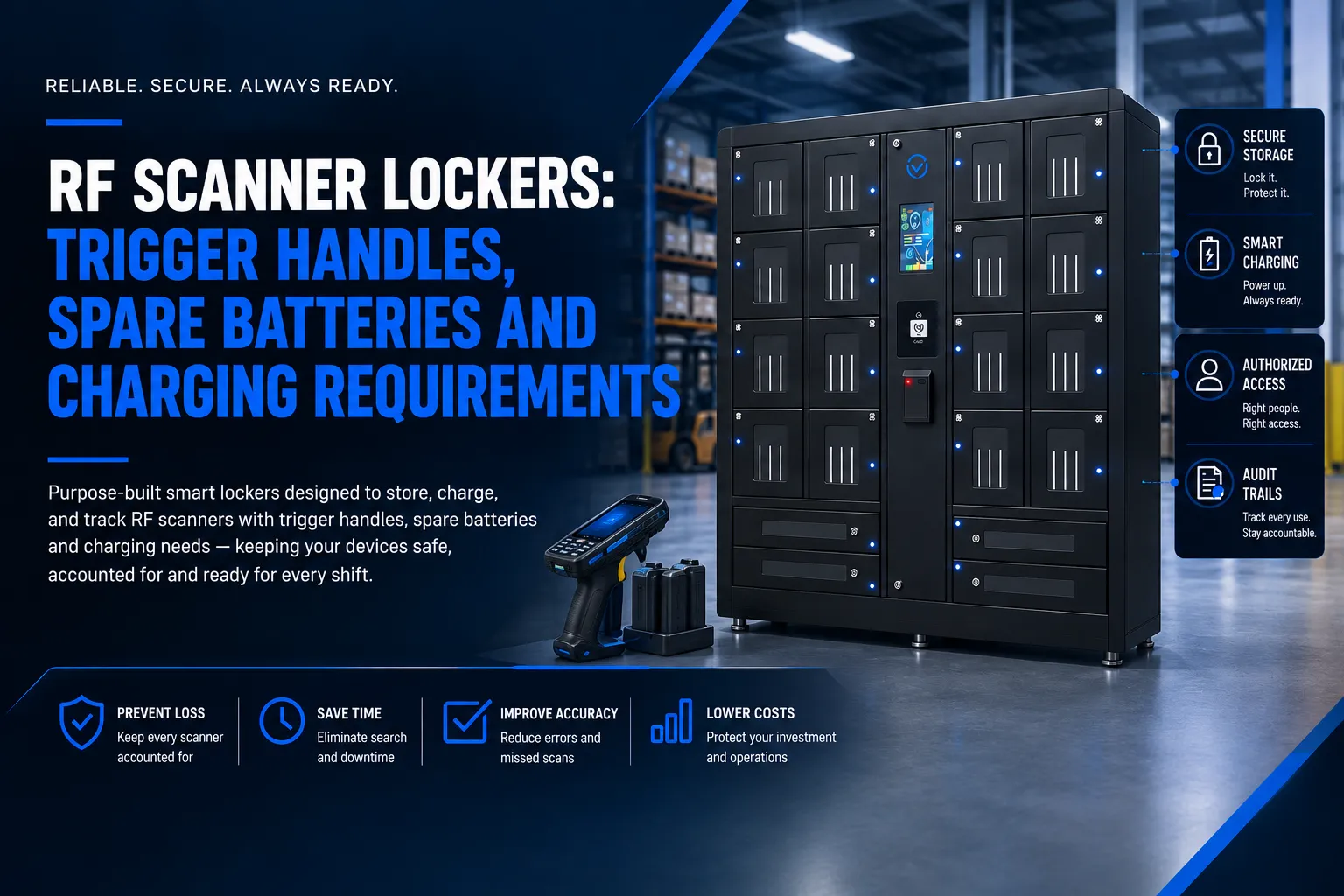
RF scanner lockers are purpose built smart locker systems designed to store, charge, and track mobile computers and barcode scanners used across US warehouses and distribution centers. When those scanners come with bulky trigger handles, standard phone-sized lockers simply do not fit. Getting the locker design, battery capacity planning, and charging infrastructure right means fewer lost devices, less downtime, and fully charged equipment waiting at every shift change.
Because 24/7 operational uptime is critical for mission-critical hardware, purpose-built RF scanner lockers maximize warehouse efficiency by preventing equipment disassembly and keeping every scanner accounted for.

How RF Scanner Lockers Work With Trigger-Handle Scanners?
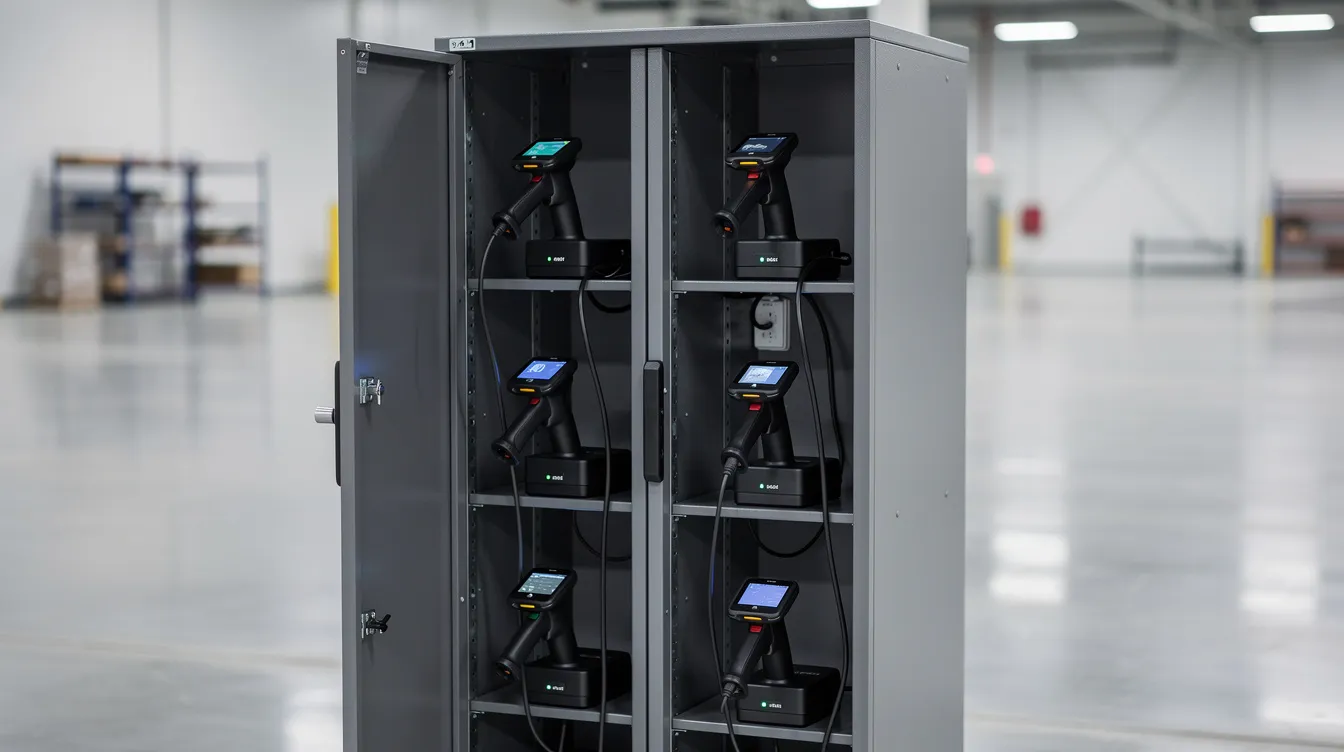
RF scanner lockers are secure, network-connected cabinets that house wireless barcode scanners and mobile computers in individual compartments. The specific challenge is that trigger handles add significant depth and width to devices like the Zebra MC33/MC93, Honeywell CK65, and Datalogic Skorpio. Standard phone or tablet lockers cannot accommodate that bulk without forcing operators to remove the handle, which wastes time and risks damage.
- RF scanner lockers with customized bay dimensions accommodate trigger handles without forcing disassembly. Trigger handles prevent the need for disassembly of devices before charging them in lockers.
- Trigger handles enhance the usability of RF scanners by allowing quick activation of the scanning function and one-handed operation while carrying inventory or equipment. The ergonomic design of trigger handles reduces strain during extended scanning operations.
- Automated docking with pogo pins ensures correct alignment for charging RF scanners. Integrated braided USB-C or proprietary cables are routed to avoid strain when scanners sit trigger-down.
- RF scanner lockers can integrate user authentication and asset tracking in their systems. Users authenticate via PIN, RFID badge, or barcode scan, a bay door pops open, and the system logs who took which device and when.
- RF scanner lockers prevent unauthorized usage by securing devices in individual compartments. Lockers can track who checked out which device using RFID or PIN access for accountability.
Configurations typically range from 24-bay to 48-bay units, depending on fleet size.
Locker Bay Design for Trigger Handles and Spare Battery Storage
Bay geometry is the single biggest factor when you combine trigger handles and spare batteries in the same locker footprint. Get the dimensions wrong, and operators jam devices, break cables, or skip the locker entirely.
- Wider door openings, low-sill thresholds, reinforced hinges, and anti-snag cable routing prevent trigger handles from catching when loading or unloading scanners. A 32-bay vertical configuration is one example of how manufacturers optimize depth for pistol-grip devices.
- Dedicated custom locker bays allow for easier device retrieval and reduced downtime during shift changes. Inside each bay, separate compartments or shelves hold spare lithium batteries or battery sleds away from the main scanner cradle.
- Smart lockers provide secure storage for shared devices, and locker systems may provide charging connections for devices while stored, so scanners charge automatically once docked.
- LED indicators per bay help shift leads confirm readiness at a glance: green means fully charged, amber means the charging process is active, red means a device is missing or a fault was detected.
Lithium Ion Battery Types in RF Scanners: Capacity and Shift Planning
Most modern RF scanners in US warehouses use lithium ion batteries, typically 3.6–7.4V packs with a unique chemistry optimized for high-cycle industrial use. Lithium batteries matter inside lockers because battery voltage, charge voltage, battery capacity, and thermal behavior all affect how the locker must be designed.
- Battery capacity ranges widely. Zebra MC3300x packs, for example, come in standard (~2,740 mAh / ~10 Wh), high-capacity (~5,200 mAh / ~19 Wh), and extended (~7,000 mAh / ~25.9 Wh) options. Larger lithium ion batteries like the 7,000 mAh pack are designed for multi-shift or heavy-scan workloads.
- For capacity planning, multiply the number of scanners by average Wh per battery by the number of shifts, then add a 20–30% buffer for overtime and seasonal peaks. A scanner drawing 2–3 W continuously needs roughly 16–24 Wh for an 8-hour shift, so a standard battery type may require two spare batteries at mid-shift while an extended pack typically lasts a full shift.
- Partial discharge best practices for lithium ion battery packs: avoid running to 0%, aim for the 20–80% range where possible, and use smart locker software to enforce return rules during breaks and shift changes.
- Honestwaves lockers work with OEM battery packs from each manufacturer. They do not alter the battery electronics; they provide controlled power and physical security.
| Battery Option | Capacity (mAh) | Energy (Wh) | Approx. Charge Time | Typical Shift Coverage |
|---|---|---|---|---|
| Standard | 2,740 | ~10 | ~2.2 hrs | Light-use 8 hrs |
| High-Capacity | 5,200 | ~19 | ~3.8 hrs | Full 8-hr shift |
| Extended | 7,000 | ~25.9 | ~5.2 hrs | 10–12 hrs / multi-shift |
Charging Requirements: Power Management Inside RF Scanner Lockers
RF scanner lockers are effectively multi-device charging cabinets, so the power supply, circuit planning, and lithium ion chargers inside the enclosure are as important as the lock on the door. Charging stations require proper electrical infrastructure for installation, and installation must comply with local electrical codes and regulations.
- USA standard input is 120V AC. A 24-bay locker draws roughly 8–12 amps at full load depending on device mix. This load planning includes external battery chargers for spare batteries and the installed charging hardware inside the cabinet.
- Multi-stage smart charging logic for lithium batteries follows a bulk → constant voltage → idle sequence. The scanner’s OEM charger electronics or battery BMS control charge termination, preventing overcharge. A faulty charger or non-OEM power output can void warranties and damage cells.
- Avoid constant trickle charging. Locker software can cut power or drop to a safe holding voltage once all devices in a bank are fully charged, protecting long term reliability.
- Charging stations can be customized for specific business needs. For facilities teams budgeting circuits, here is a quick reference for efficient charging setups:
| Locker Size | Idle Power | Max Load | Approx. Amps (120V) | Breaker Recommendation |
|---|---|---|---|---|
| 12-bay | ~10 W | ~500 W | ~5 A | 15 A dedicated |
| 24-bay | ~20 W | ~1,000 W | ~9–12 A | 15–20 A dedicated |
| 48-bay | ~40 W | ~2,000 W | ~18–20 A | Two 15–20 A circuits |
Safety and Compliance: Lithium Batteries and Smart Locker Design
US safety expectations include UL/ETL listed power components, OSHA-aware layouts, and clear lithium battery handling procedures. Lithium metal batteries and larger batteries with exposed terminals pose a short circuit risk if stored improperly.
- Never charge a battery if the casing is visibly swollen, cracked, or has been submerged. Remove and quarantine damaged units immediately. This applies to both device batteries and spare batteries stored in locker bays.
- Following airline approval and NFPA-style guidance, avoid stacking loose spare lithium batteries with exposed terminals. Use individual slots or protective caps inside the locker, similar to carry on baggage rules for personal electronics and portable electronic devices.
- Ventilation matters. Perforated back panels or side vents prevent temperature buildup around charging batteries. Warehouse ambient ranges can exceed 90°F in summer, which pushes lithium cells closer to thermal limits.
- Contactless credential verification with encrypted RF IDs reduces theft and credential cloning risks. RF scanner lockers enhance asset security by reducing the risk of devices being misplaced.
- For sensitive facilities, tamper-proof storage solutions are essential. Data blocking technology prevents unauthorized access to devices and is used in secure charging stations designed for controlled environments. It ensures compliance with security standards like HIPAA, where HIPAA compliance requires secure sanitization for clinical tablets. Tamper-proof storage solutions meet stringent security requirements across healthcare and government settings.
Operational Workflows in Warehouses, Retail and Distribution Centers
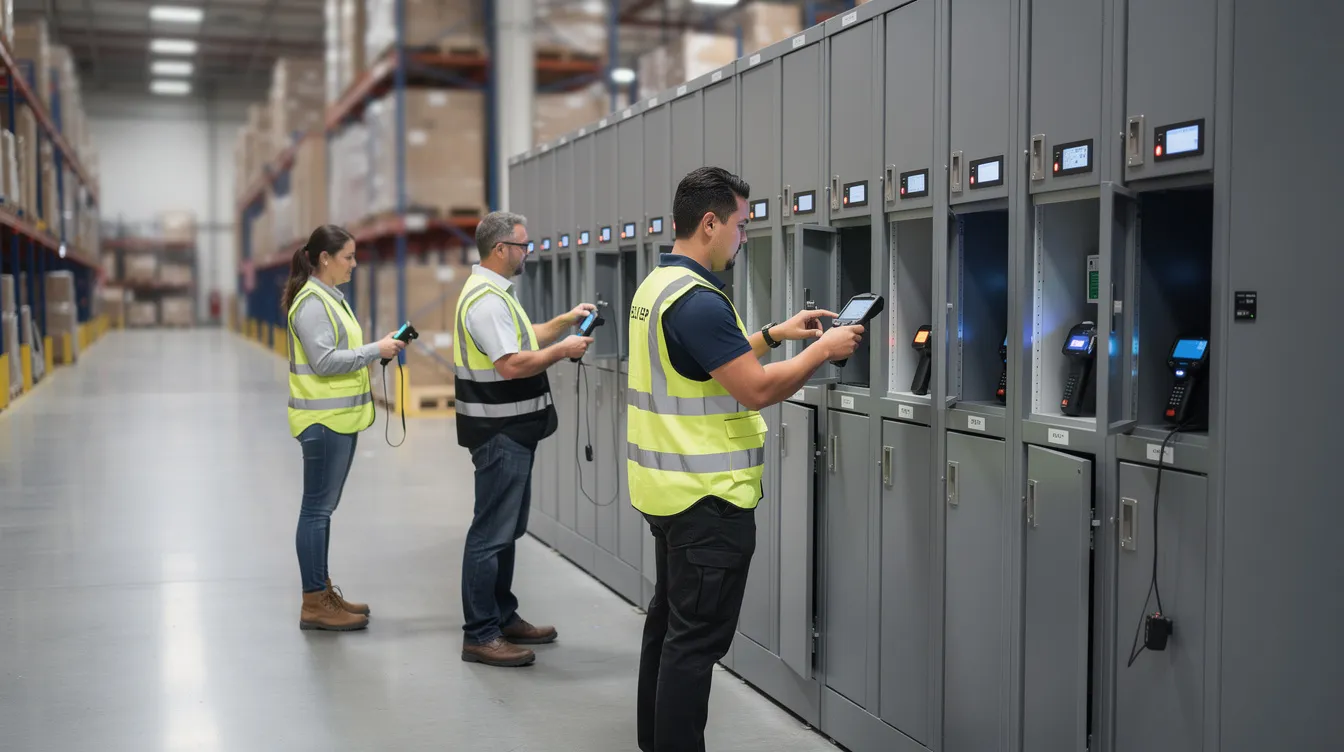
A typical USA distribution center workflow looks like this: the night shift drops scanners into the locker, the system logs the check in, and by morning every device is fully charged and ready for day-shift pickup. Smart lockers can log access times to enhance operational accountability, and centralized check out processes reduce IT overhead for devices.
- Distribution centers: Assign one bay per device, link each bay to specific departments (receiving, outbound, inventory control), and use analytics to spot underutilized scanners. One Midwest distributor with 10 facilities eliminated all unreported device losses and achieved full ROI within three months.
- Retail operations: Place a smart locker near the stockroom. Store associates check out scanners at shift start via employee ID badge, cutting shrink by tracking who had which device when. Charging stations should be accessible to all users in facilities.
- Hospitals and clinical logistics: Secure RF scanners used in pharmacy or supply chain by integrating with existing RFID badges. UV-C disinfection eliminates up to 99.9% of pathogens and is effective against viruses and bacteria. UV-C disinfection is used in healthcare settings for sanitization as a chemical-free sanitization method. UV-C technology can be integrated into charging stations, making it practical to combine clinical device management with disinfection for shared tablets and scanners. Lockers ensure HIPAA compliance for clinical tablet storage.
- Schools and campuses: Lockers automate student device management, and standardized device programs reduce IT overhead in schools, keeping laptop computers, cell phones, and tablets organized.
Smart Locker Software: Access Control, Analytics and Integrations
Hardware is only half the solution. Cloud-connected smart locker software provides the accountability and data that drive continuous improvement and device management capabilities across your operation.
- Authentication methods include RFID badges already used for time clocks, PIN codes, or QR codes. Each checkout is tied to an individual employee record for full audit trails.
- Integrations connect locker events to WMS or ERP systems (Manhattan, Blue Yonder, SAP EWM) via API, so supervisors see scanner availability alongside workload data. The system can also connect to IT ticketing platforms for damage reporting.
- Usage analytics can track user engagement at charging stations. Data analytics helps manage device usage effectively. Dashboards show average checkout time, devices not returned at shift end, battery health indicators, and bay utilization rate. Analytics can improve engagement for event attendees using charging solutions as well.
- Honestwaves follows its own privacy, data, and terms-of-use policies. Customers configure retention durations and role-based access to locker usage reports, keeping management and security aligned with specific needs.
Honestwaves RF Scanner Locker Options and Use Cases?
Honestwaves is a B2B provider of smart lockers, phone charging stations, and portable charging kiosks for US businesses. The company offers a lifetime warranty and supports large-order deployments with dedicated setup assistance.
- Scanner-first configurations include the 24-bay charging locker for scanners with trigger handles and mixed-use towers combining scanner bays with smaller phone-sized bays for portable rechargers, power banks, or camera equipment.
- Customization covers color-matching to corporate branding, bay labeling by zone (Aisle 100–200), vinyl wraps with operational instructions or safety signage, and new lockers scaled to size covers your entire fleet.
- Complementary products include smart phone charging lockers at employee entrances, charging tables that provide power access for users in break rooms, and portable kiosks available for hardware rentals during peak season. Hardware rentals include secure phone charging stations, and rentals help reduce IT overhead for device management. Smart lockers can be customized for event attendees, and secure charging solutions enhance user engagement at events.
- Learn more about how smart lockers work and what they cost in 2026.
- Ready to plan your layout? Get a Quote for a tailored RF scanner locker configuration and power plan matched to your operation.
FAQs
Do trigger handles need to be removed before storing scanners in a locker?
No. Lockers designed for RF scanners with trigger handles use wider, deeper bays that accept the scanner fully assembled. Removing the handle wastes time and risks damage.
How long does it take to charge RF scanner lithium batteries inside a locker?
Typically 2–5 hours depending on battery capacity and charger amperage. A standard 2,740 mAh pack reaches about 90% in roughly 2.2 hours; a 7,000 mAh extended pack takes closer to 5.2 hours. Optimal performance depends on using OEM-rated charger output and maintaining ambient temperature below 40°C.
Can lockers safely store spare lithium batteries alongside scanners?
Yes, provided terminals are protected in individual slots or caps, batteries are undamaged, and your facility follows its own battery safety SOPs and any applicable US regulations. Solar panels and other auxiliary power sources do not change this requirement.
What happens if an employee forgets to return a scanner?
The software sends alerts to supervisors via email or SMS and maintains a timestamped audit trail. Managers can quickly identify who last checked out the device, disconnect access privileges if needed, and track the unit’s last known bay.
What are the installation requirements for an RF scanner locker?
You need a standard 120V outlet on a dedicated circuit, a data connection (Ethernet or Wi-Fi) for cloud features, and basic anchoring with clearance for ventilation. Contact Honestwaves for site-specific planning based on your floor layout and the number of units you need installed.
Are these lockers suitable for valuable equipment beyond RF scanners?
Absolutely. The same locker infrastructure supports tablets, laptop computers, cell phones, portable electronic devices, and camera equipment. Advanced features like data blocking and UV-C disinfection make them suitable for healthcare, education, and government environments with strict security and compliance requirements.