
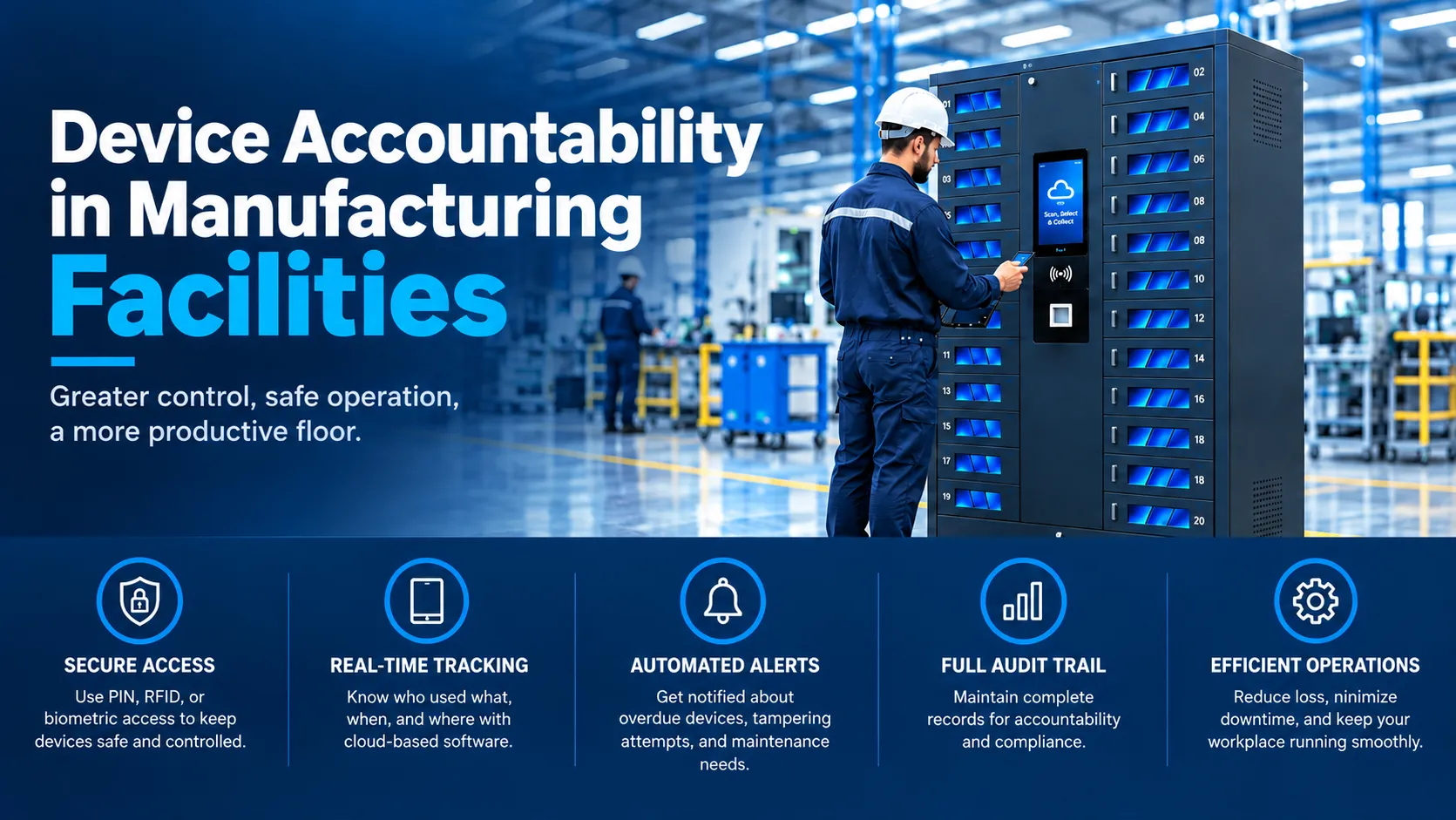
It’s 2024, midway through a Tuesday afternoon shift. A shared tablet loaded with critical work instructions vanishes from the floor. Nobody knows who had it last. Nobody knows if it’s in Receiving, someone’s locker, or sitting under a pile of packaging in the break room. Three hours later, the production line is still stalled. Lost labor hours. Missed customer commitments. One missing device, and the whole schedule falls apart.
That’s what happens when device accountability in manufacturing facilities is treated as an afterthought. At its core, device accountability in manufacturing refers to the systematic tracking and management of hardware assets so teams always know each device’s location, user, status, and security. For manufacturing managers, supervisors, quality teams, and compliance leaders—especially in regulated environments—this is the difference between controlled operations and constant guesswork. Real time monitoring, access control, audit trails, and automated locker alerts for overdue, tampered, or maintenance-needs devices help stop small issues before they turn into line stoppages, data gaps, or security incidents.
The stakes go beyond inconvenience. In medical device manufacturing, a missing or degraded tablet can compromise patient safety and clinical data integrity while creating downstream challenges for audits, traceability, outsourced data management, and regulatory compliance. In any facility, poor accountability leads to downtime, scrap, quality issues, failed audits, and, in regulated environments, product recalls as problems move downstream unchecked. Accountability supports quality plan requirements, condition monitoring, secure charging, data blocking, UV-C disinfection, and usage analytics that expose bottlenecks and support continuous improvement. Smart charging lockers and phone charging stations from HonestWaves support this by tying every device checkout and return to a specific person, shift, and timestamp.
Here are the four pillars that hold it all together:
- Location: where is the device right now?
- Ownership: who checked it out and when?
- Status: is it charged, damaged, or overdue?
- Security: is access controlled and data protected?
From Clipboards To Cloud: How Device Accountability Has Evolved
Before 2015, most manufacturers tracked shared devices with paper sign out sheets, key cabinets, and a whole lot of trust. Someone forgot to log a scanner? You wouldn’t know until next shift. That system “worked” in the same way duct tape works on a leaky pipe. It held, until it didn’t.
The shift happened because factories changed. Industry 4.0, the growth of medical device manufacturing, and stricter expectations for medical device traceability and clinical data integrity made informal systems unacceptable. Documentation is essential for regulatory audits in manufacturing, and ISO 13485 requires clear documentation and records for accountability. The FDA mandates written Standard Operating Procedures for traceability. Medical devices must be traceable across the product lifecycle, and the same documentation discipline should extend to shared devices used throughout that process.
Connected smart lockers now log every interaction automatically, removing the need for manual logging and reducing pencil whipping.
| Old Way (2010) | Current Best Practice (2026) |
|---|---|
| Paper sign out sheets | RFID / PIN / badge access |
| Keyed cabinets, single keyholder | Self serve smart lockers |
| Local paper logs | Cloud connected dashboards |
| Trust based returns | Automated overdue alerts |
| No condition tracking | Real time status monitoring |
Real world results back this up. At a GXO and Nestlé site, moving from paper and single key systems to RFID tracking with full audit trails reduced device loss and damage while freeing supervisors from manual tasks. Columat reported that smart lockers reduced tool loss by up to 60% and cut manual management costs by roughly 70% at ID Logistics warehouses.
Core Building Blocks of Device Accountability in Manufacturing Facilities
Every solid accountability system rests on a handful of essentials. These apply whether you’re managing handheld scanners in automotive, shared phones on a warehouse floor, or tablets controlling a medical device on an ISO 13485 production line.
- Access control: only authorized people check out devices. Best practices include enforcing role based access controls for device management.
- Traceability and audit trail: every checkout, return, and damage report is timestamped and tagged to a user. Unique identifiers and calibration status are vital for effective device management in manufacturing environments.
- Condition and status monitoring: flag damaged devices, track battery health, usage hours, error logs.
- Security: locked bays, tamper detection, data blocking during charging. Device accountability enhances cybersecurity by preventing unauthorized device connections.
- Charge and readiness management: devices come back charged, updated, and ready for the next shift.
Establishing a clear device accountability framework helps reduce compliance gaps in organizations. In regulated facilities, these controls should align with broader quality management systems. Maintaining a dynamic asset inventory involves tracking all device attributes and statuses. These building blocks plug directly into the broader manufacturing process and manufacturing lifecycle, especially where regulated products, risk management, or patient safety are involved.
HonestWaves hardware combines these in one system: controlled access, audit trails, smart locker alerts, and built in device charging.
Smart Locker Alerts: Overdue Devices, Tampering and Maintenance
Here’s a scenario you’ve probably lived through. End of night shift. Scanner number 17 didn’t come back. Nobody’s sure who had it. The morning team shows up short a device, and suddenly you’re scrambling.
With smart locker alerts, that situation plays out differently. The system knows scanner 17 was checked out by a specific user at 10:14 PM. When it isn’t returned by end of shift, an overdue alert fires off to the supervisor by email or dashboard. Problem identified before the morning crew even clocks in. Automated monitoring improves device usage tracking and enables proactive equipment maintenance.
How many times have you heard “I think it’s in Receiving somewhere” when a device disappears? These alerts eliminate that guesswork. Here’s what they look like in practice:
Overdue device alerts
- Triggered when a phone, tablet, or handheld isn’t returned by its scheduled time
- Notification sent to the supervisor referencing the named user and device ID
- Helps prevent lost devices and keeps the supply chain of equipment flowing
Tamper alerts
- Fired when a locker door is forced open, left open too long, or accessed outside approved hours
- Incident response relies on accountability to track which devices were affected during security events
- Creates a documented trail for safety and compliance review
Maintenance alerts
- Based on usage analytics, charge cycles, or error logs signaling a device is becoming unreliable
- Supports preventive action instead of constant firefighting
- Keeps devices out of critical operations until inspected
These alerts connect directly to accountability in manufacturing. They prevent wandering equipment, provide a documented trail of who last had each device, and support preventive action across every shift. Automated alerts help prevent significant errors in manufacturing before they cascade into bigger problems.

Access Control, Permissions and Real Time Visibility
Think of access control less as “Big Brother” and more as “who’s responsible for what.” Operators, maintenance, quality assurance, and supervisors each need different permissions for shared devices and locker bays. Regulated industries require strict standards for device accountability and compliance assurance, and role based access makes that practical instead of painful.
This becomes especially critical when a device is used to adjust a medical device or record clinical data in a regulated area. You need to know exactly who touched what. Visibility enables tracking of who did what and when.
Cloud connected smart lockers from HonestWaves can:
- Restrict access by RFID badge, PIN, or SSO integration
- Limit which shifts or departments can use certain high value devices
- Provide real time dashboards showing which devices are checked out, available, or charging
- Feed data points that enhance visibility in manufacturing operations
Here’s where continuous improvement gets real. Say your locker logs show the 6 AM shift on Line 3 is consistently short of scanners. That’s not a people problem. That’s an inventory distribution problem. You rebalance, and suddenly that line stops losing 20 minutes every morning. Visibility leads to improved compliance with quality standards, and it helps the leadership team make better decisions about where to focus resources.
What should your dashboard show? User name, device ID, checkout time, locker bay number, battery status, and return status. Simple, but powerful.
Inventory, Traceability and Preventive Action for Shared Devices
If you’re in medical device manufacturing, you already track raw materials, lots, and finished product from component sourcing through distribution. Why wouldn’t you apply the same discipline to the devices that capture, record, and control your manufacturing process?
ISO 13485 requires clear documentation for traceability in medical devices. Class II and Class I devices require tracking orders for safety compliance (Class II and III devices specifically require tracking orders). Manufacturers must maintain comprehensive Design History Files (DHF). Manufacturers have three working days to provide device information, and manufacturers have three working days to provide device information before distribution. Traceability enhances accountability by tracking every manufacturing step.
A simple digital inventory model looks like this:
- Unique device ID (serial number, RFID tag)
- Last known location (locker bay, work cell)
- Status: in use, charging, maintenance due, damaged
- User assignment: who has it and since when
- Battery health and error history
This level of visibility supports faster audits, quicker root cause analysis when bad data entry is tied to a particular tablet, and predictive preventive action like swapping devices before they fail in critical cells; for example, it can show every device involved in a specific production issue in seconds. Accountability drives continuous improvement across the manufacturing lifecycle.
Imagine a supervisor in June 2026 pulling a quick report in under 60 seconds showing every device touched during a problematic production run. That’s not fantasy. That’s what a connected warehouse asset management system delivers today. In the HonestWaves distribution center deployment, facilities saw a 100% reduction in unreported device losses within 60 days, ROI in under three months, and saved over five hours per week per location on oversight.
Using Smart Lockers to Build a Culture of Accountability, Not Fear
Here’s the part nobody talks about enough. If your team sees smart lockers as surveillance, you’ve already lost. Personal accountability works when it’s paired with systems that support people, not punish them.
Many manufacturing leaders now recognize that most quality issues and device losses are system problems, not people problems. When night shift constantly “loses” devices, the knee jerk reaction is to assume laziness. But locker analytics might reveal something different: there’s no formal handover process at shift change, so devices stay in pockets or get left at workstations. Once you fix the process and add reminders, device loss drops sharply. Not because people are scared, but because the system stopped setting them up to fail.
This cultural shift matters enormously in medical device and high hazard environments. When the team knows they’ll be held accountable through clear expectations and reliable tools rather than blame, they’re more likely to report damage honestly, flag potential issues early, and maintain consistent quality. The organization benefits because this approach helps teams operate to a higher standard. The product quality improves. And the people on the floor feel respected instead of watched.
Use dashboard data in daily meetings. Show device downtime, damage rates, return patterns. Transparency helps everyone see how their habits affect colleagues and production. That’s how you implement corrective actions that actually stick.

Where HonestWaves Fits: Real Examples From the Floor
Let’s get specific. A US based medical device manufacturing facility in 2025 deployed HonestWaves smart lockers to manage tablets used for capturing lot history and clinical data related notes at each workstation. Every tablet checkout was tied to a badge, every return logged. When an auditor asked who used which device during a specific batch, the answer took seconds, not hours. Healthcare providers and medical device manufacturers operating under FDA regulations need that kind of capability.
On the automotive side, a large plant used portable charging kiosks and charging tables on temporary production lines. Even on a line that only runs for eight weeks, full device accountability was maintained via cloud connection. No waste, no guesswork.
Here’s what HonestWaves smart locker solutions bring to the table:
- Data blocking technology for USB ports, so shared devices charge safely without exposing data or creating cybersecurity risk
- UV C disinfection bays for devices moving between clean areas and general production, directly relevant to patient safety and infection control in cleanrooms
- Usage analytics that highlight overdue devices, locker tampering, and maintenance trends across months, helping you track performance and meet industry standards and efficacy standards
- Storage designed for multiple device types, from RF scanners to tablets to radios
For facilities not ready to commit to a full purchase, HonestWaves offers rental options for pilot projects. Test accountability on one line during a short term continuous improvement initiative without a huge capital outlay. If it works, and it usually does, scale from there.
Frequently Asked Questions
How do smart locker alerts actually work day to day?
Alerts fire automatically when a device is overdue, a locker is forced, or maintenance thresholds are hit. They’re sent to supervisors by email, SMS, or shown in a web dashboard.
Can smart lockers help with regulated medical device manufacturing audits?
Yes. Detailed locker logs and device traceability reports support ISO 13485, FDA, and EU MDR expectations by showing who used which device, when, and for what manufacturing process step.
What if workers forget to return devices to the locker?
Overdue device alerts and simple return reminders usually fix this. Pairing alerts with clear expectations works far better than strict punishment. You can also stop RF scanners going missing between shifts with the right setup.
Do I need new devices, or can I use the ones I already have?
Most HonestWaves charging lockers and kiosks are device agnostic. They secure and charge existing phones, tablets, and scanners as long as they fit and use compatible charging cables. No need to reverse engineer your whole device fleet.
Is this only worth it for huge factories?
Even a small facility with 15 or 20 shared devices benefits from reduced loss, faster shift handovers, and better accountability in manufacturing. The ability to halt production issues before they grow matters regardless of facility size, and the system scales for multiple markets and operations.
Conclusion
Device accountability isn’t a nice to have anymore. It’s the foundation for reliable operations, strong regulatory compliance, and the kind of continuous improvement that actually sticks. When you always know where each device is, who has it, and what shape it’s in, you stop firefighting and start leading a floor that works.
Start small. Pick one area or line where device chaos is most obvious. Map current flows, losses, and frustrations. Consider piloting a set of HonestWaves smart charging lockers or a portable charging kiosk under a rental program to test smart locker alerts and ensuring accountability in real life.
If you’re tired of hunting for missing tablets ten minutes before a run starts, reach out to HonestWaves for a quick walkthrough and a quote. We’ll help you design a device accountability setup that fits your floor, not someone else’s brochure.