
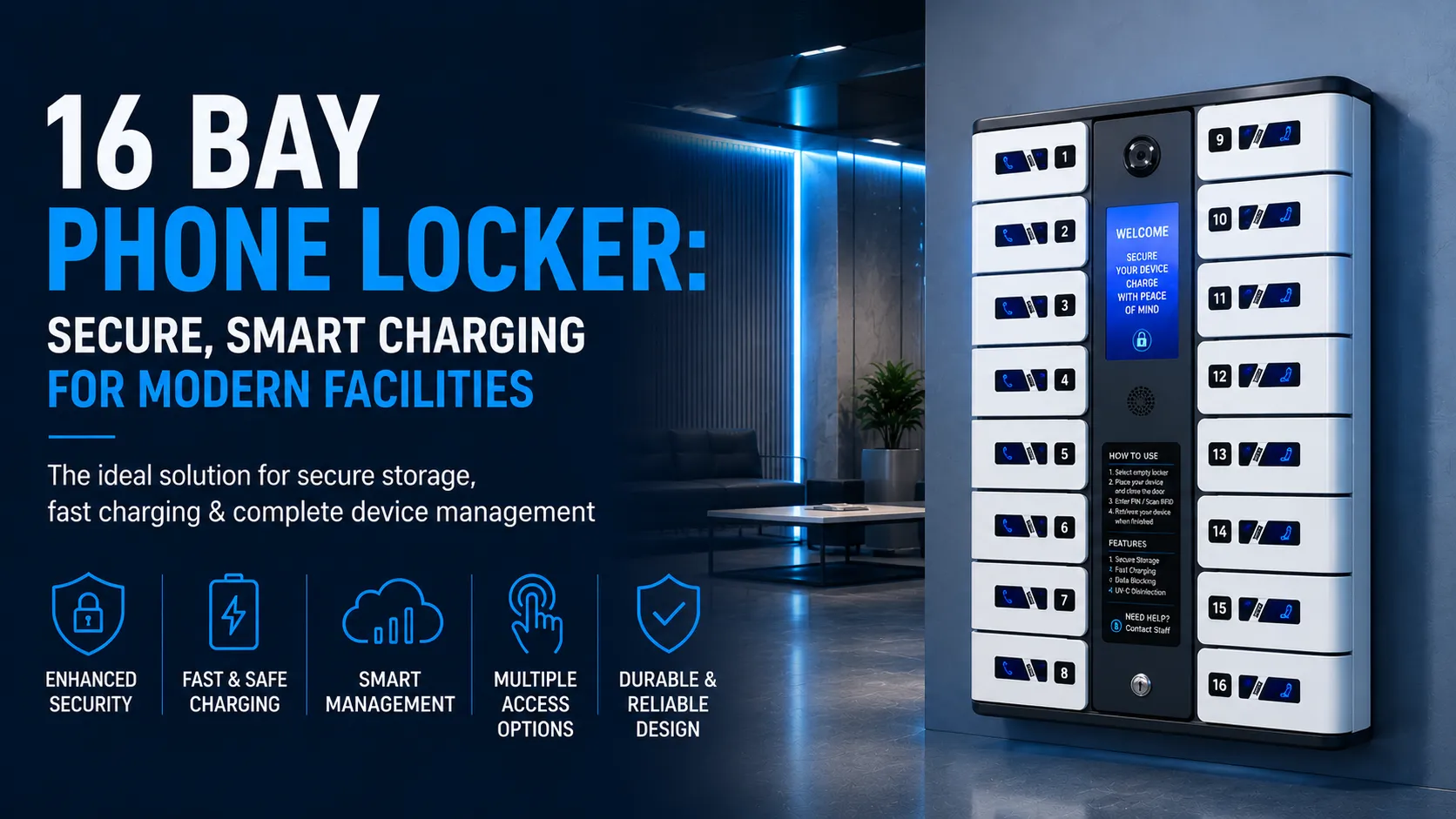
Every facility eventually hits the same wall: phones need to be stored, charged, or kept off the floor – and sticky notes on a shared power strip don’t cut it anymore. A 16 bay phone locker solves this without overcomplicating your infrastructure or blowing your budget.
- A 16 bay phone locker is a wall-mounted or floor-standing smart locker with 16 individually secured bays, each with integrated charging for smartphones and small personal devices. Honestwaves designs these as cloud connected, software managed units – not just metal boxes with outlets.
- The 16 bay capacity hits the sweet spot for medium-traffic environments like corporate offices, healthcare facilities, universities, and staff areas that need secure phone charging and controlled access without the footprint of a 30+ bay system.
- Core benefits include secure storage, fast charging, centralized asset management, reduced IT overhead, audit trails, and a dramatically better user experience compared to ad-hoc outlets or basic charging stations.
- Honestwaves offers data-blocking ports, optional UV-C disinfection, a lifetime hardware warranty, and both purchase and rental options for its 16 bay smart charging locker.
What is a 16 Bay Phone Locker?
A 16-bay phone locker is a secure storage unit with sixteen individual compartments, each designed to hold and charge a smartphone or similarly sized device. Individual compartments allow multiple users to store devices simultaneously in a compact footprint – typically around 23–25 inches wide and 8–10 inches deep for a wall-mounted unit.
The physical layout is usually 4×4 or 2×8 bays, built from steel or aluminium with front-access doors. Each compartment includes usb c or USB-A ports; many models include built-in USB or AC power outlets for charging inside each bay. Bay dimensions are sized for smartphones, ID badges, wallets, keys, and small accessories – not laptops or tablets.
What separates a phone locker from general charging lockers? Bay geometry. Phone-optimized bays are smaller (roughly 4.75″ × 5.5″ × 7″ per compartment), drawing less power per bay and taking up less floor or wall space than mixed-device systems built for more laptops and tablets.
Common use cases include staff phone storage in secure areas, visitor phone charging in lobbies, prototype phone management in R&D labs, and device check-in at training centres. Honestwaves’ smart locker units go beyond mechanical cupboards: they include electronics for access control, analytics, and optional software dashboards.
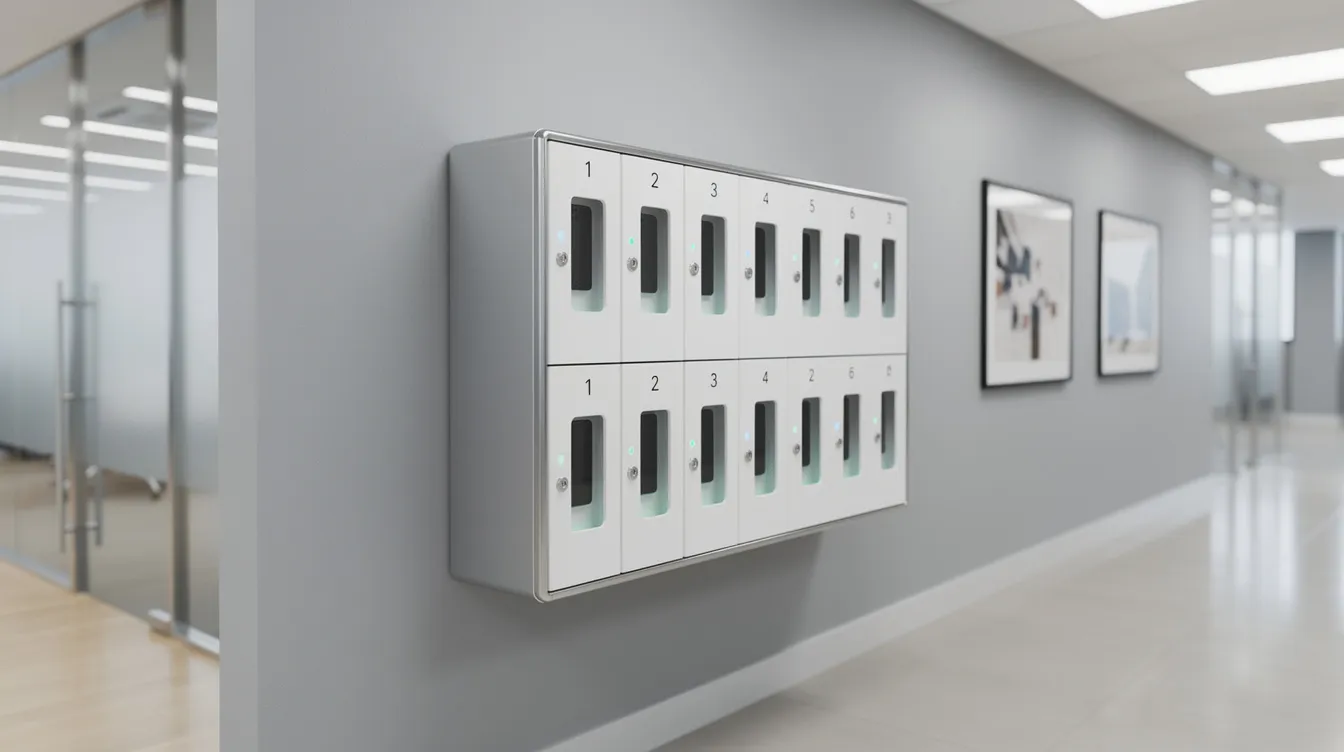
Why Choose a 16 Bay Configuration Instead of Other Sizes?
Charging lockers can range from six to over twenty bays and charging lockers can have 20 or more bays for high-density deployments. So why 16?
A 16 bay phone locker fills the gap between compact 8 bay units (good for a small team or lounge) and high-density 30+ bay systems built for large lobbies or student unions. For environments handling 50–150 daily users with staggered usage, 16 bays deliver full utilization without dead space or wasted cost.
Concrete scenarios where 16 bays work well:
- A 120-person corporate office floor where teams rotate through meetings and need a place to store phones
- A 24-bed hospital ward across two shifts, where roughly 50 staff plus visitors cycle through
- A university department with rotating student cohorts checking in phones for exams or labs
The footprint stays modest – a single wall segment handles the unit – and the cost per bay stays competitive. Operationally, managing bay allocation per shift or per department is straightforward. And if demand grows, Honestwaves lets you network multiple 16-bay units under one cloud platform rather than forcing a single oversized purchase.
Core Features of Honestwaves 16 Bay Phone Lockers
Here’s what a B2B buyer actually gets inside Honestwaves 16 bay phone lockers:
Integrated charging: Each bay is equipped with fast-charging USB-C and USB-A ports delivering up to 20W per device. Data-blocking technology prevents data transfer – StarTech’s charge-only cables, for example, physically remove data pins while still supplying 5V/2.4A. Surge-protected internal power distribution handles all 16 bays simultaneously. Charging lockers support USB-C charging for devices, and usb c charging is standard in high-security device lockers. Charging lockers also support USB-C charging and RFID access as part of the integrated platform.
Physical security: Durable construction with heavy-duty steel helps prevent theft or damage. Reinforced hinges, shrouded locks, and tamper-resistant doors keep contents safe. Solid doors provide privacy for confidential prototype devices. LED bay status indicators show in-use, available, or fault states. Charging lockers have individual, lockable compartments for devices, and each compartment allows devices to charge securely while stored.
Access methods: A typical 16-bay phone locker may have key, combination, pin, or RFID locking options. RFID/NFC access enhances security for device checkout, and optional integration with existing staff ID cards or student IDs streamlines authentication.
UV-C disinfection: Charging lockers may include options for UV-C disinfection – Honestwaves offers modules that run short cycles killing 99.9% of pathogens, particularly useful for healthcare facilities and food-handling environments.
Connectivity: Cloud-connected smart locker hardware over Ethernet or Wi-Fi enables remote monitoring, firmware updates, and usage analytics dashboards. They are designed for devices like laptops, tablets, and phones, though the 16-bay format is phone-optimised. Charging lockers support secure storage for powered equipment, and charging lockers allow devices to charge while securely stored.
Benefits for Key Environments: Healthcare, Corporate Offices, and Education
Different sectors get different value from the same 16-bay unit. Here’s how it breaks down.
In healthcare facilities – acute hospitals, outpatient clinics, behavioural health centres- 16-bay phone lockers keep phones off the clinical floor. Healthcare facilities utilize secure lockers to protect patient privacy and HIPAA compliance. Staff can secure personal devices during shifts, and visitors get safe phone charging in waiting areas. At Erie County Medical Centre, smart lockers ensured devices were “charged and ready for use 100% of the time” across roughly 55 providers. Hospitals tightening smartphone policies between 2023 and 2025 have driven this adoption hard.

In corporate offices, workplaces use phone lockers for productivity, safety, or confidentiality reasons. Lockers reduce cluttered cables, centralize phone charging for hybrid teams, and support clean desk policies in secure zones like labs or trading floors. Lockers should comply with no-phone policies in secure areas like data centers. Lockers promote focus during high-concentration workshops and meetings, and a 16-bay phone locker helps prevent data leaks in secure environments. Secure lockers improve compliance with organizational device management policies. Individual locking doors help prevent unauthorized access to users’ devices.
For schools and universities, lockers in schools reduce distractions and support classroom policies. Phone lockers stop cheating on tests and reduce social media drama among students. IT teams can also use 16 bay units to manage shared devices, loaner phones, or test equipment. Device management lockers from Honestwaves serve this exact workflow.
Smart Locker Capabilities and Asset Management Workflows
A smart locker is software-controlled: user authentication, event logging, centralized management. That’s fundamentally different from a mechanical phone charging station with a padlock.
Asset management capability goes beyond storing personal devices. You can assign specific bays to specific users, log check-in and check-out times, capture who accessed each bay, and generate audit trails for compliance or loss prevention. A 16 bay phone locker handles shared devices too – pool smartphones, Wi-Fi hotspots, access fobs, scanners, radios, or cameras that rotate between shifts. When one team finishes and the next shift starts, devices are charged, accounted for, and ready.
Configurable workflows include:
- Self-service pin on first use
- IT-administered reservations
- Timed loans with automatic alerts for overdue returns
- Role-based access controls for managers vs. standard users
Honestwaves platform offers cloud dashboards, API options for integration with HR or ticketing systems, and exportable CSV reports to support audits and budgeting. At Singapore General Hospital, scaling locker units saved approximately 0.88 pharmacist FTE – roughly $80,000 in annual labor costs by streamlining device and equipment workflows.
Integrated Charging and Fast Charging Technology
Integrated charging means power outlets and electronics are fully built into the locker, eliminating external power strips, loose chargers, and unsafe DIY modifications. You don’t plug in a power bar and hope for the best.
Fast charging profiles for Honestwaves units include USB-C PD charging (e.g., 9V/2.22A or 12V/1.67A), adaptive current limiting, and per-bay power management to avoid overload. Each bay delivers up to 20W – enough for any modern smartphone. The smart charging locker logic prioritizes bays with low-battery devices first, runs nightly energy saving modes, and uses health conscious charging curves that avoid overheating phones.
Safety features built into every unit:
- Overcurrent protection per bay
- Thermal monitoring across the enclosure
- Ventilation designs that keep internal temperatures within safe ranges when all 16 devices charge simultaneously
- Support for lightning, usb c, and micro USB cables depending on site configuration
Compare that to unsecured wall outlets or basic plug-in lockers. Integrated charging improves reliability, reduces trip hazards, and gives building management clear oversight over power draw and daily operations.
Mounting Options, Footprint, and Installation Considerations
Honestwaves 16 bay phone lockers ship as wall-mounted units or slim floor-standing cabinets, depending on your building constraints and user flow.
Wall-mounted installations work best in corridors, staff rooms, and reception areas. Ideal mounting heights keep lower bays accessible for wheelchair users (ADA compliance requires operable parts no higher than 48 inches from the floor). Backing requirements vary: stud mounting for drywall, direct bolting for masonry. A typical unit weighs around 40–50 lbs and measures roughly 23–25 inches wide by 28–30 inches high.
Floor-standing options use base plinths and anti-tip brackets. These connect into reception areas, lobbies, or training rooms without requiring wall modifications. A locker stand makes repositioning easy if your site layout changes.
Power and network: A standard 110–240V outlet nearby handles most installations. Optional hardwired circuits suit high-usage sites. Ethernet or Wi-Fi keeps the unit connected to Honestwaves’ cloud platform.
Honestwaves provides site surveys, CAD layout suggestions, and coordination with your facilities team. A single wall-mounted unit typically installs in under half a day once power is in place.
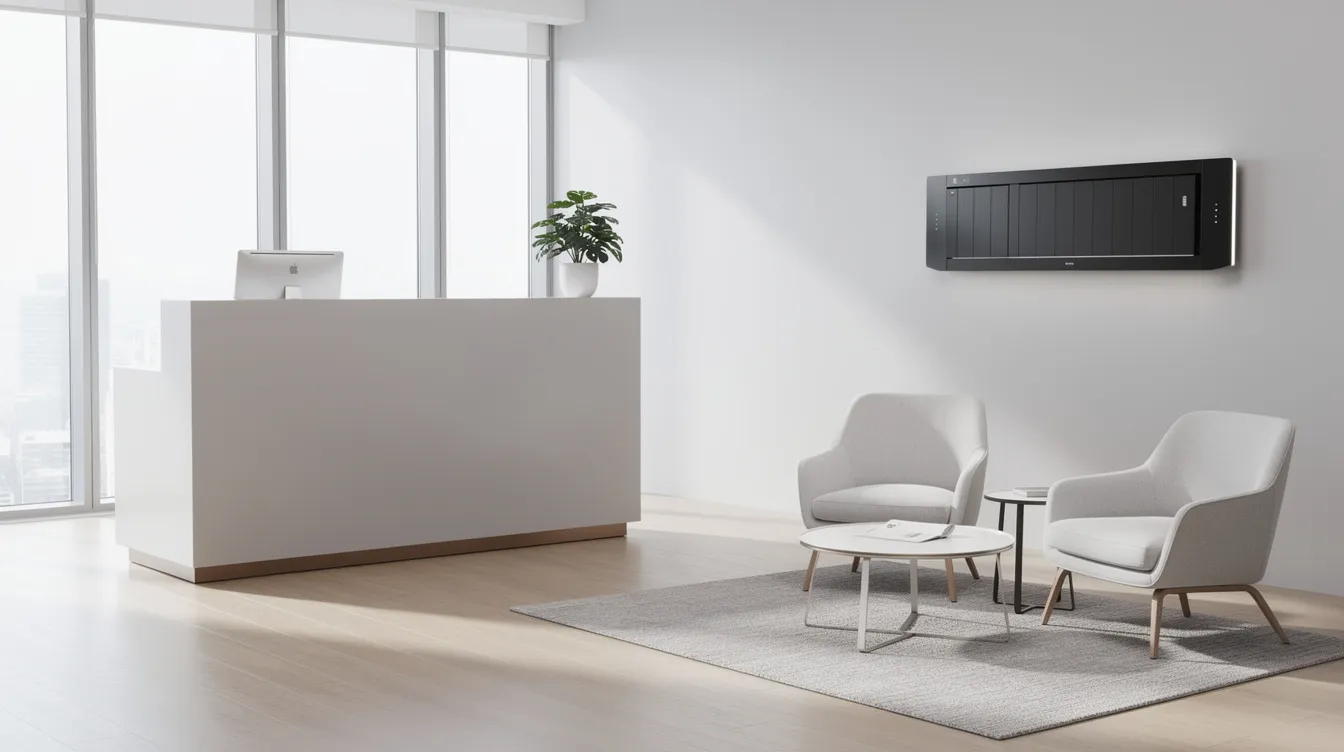
Security, Privacy, and Compliance
Security in a 16 bay phone locker comes in layers: physical robustness, digitally controlled access, and privacy protections.
Physical measures include tamper-resistant doors, concealed hinges, robust lock mechanisms, and optional CCTV-friendly status lights that flag unauthorized attempts without exposing the stored contents. The environment stays secure whether you’re dealing with visitors, guests, or staff.
PIN and RFID access is managed through user credential provisioning, with lost PIN reset workflows handled by administrators. Multi-factor verification is available for higher-risk zones. The app-based or badge-based access integrates with existing campus or corporate ID systems.
Data-blocking technology within Honestwaves’ charging ports allows power-only connections, preventing data syncing or malware transfer. This addresses the growing concern around “juice jacking” – where compromised USB ports steal data from connected phones.
For compliance, clinical device management in hospitals requires HIPAA-aligned audit logging. Honestwaves’ platform logs every bay interaction, supporting investigations of lost or damaged valuables and satisfying corporate information security policies.
Buying, Renting, and Scaling with Honestwaves
Honestwaves offers both purchase and rental options for 16 bay phone lockers, giving facilities flexibility for permanent installations and temporary deployments alike.
Outright purchase includes hardware ownership, lifetime hardware warranty, and recommended multi-year software and support plans for smart locker capabilities. Non-charging 16-door storage lockers from competitors start around $1,675; charging versions with smart features run higher, but Honestwaves bundles analytics, security, and warranty into the cost.
Rental or event-based models cover short-term needs – conferences, exams, seasonal peaks. Logistics are handled end-to-end: delivery, setup, remote monitoring, and teardown. Portable phone lockers are useful in gyms, events, and public venues for secure storage.
Organizations can start with a single 16 bay smart locker and expand to a fleet across multiple floors or campuses, all monitored through the same cloud interface. Check the Smart Locker RFP Guide to streamline your evaluation process.
Ready to move forward? Get a Quote from Honestwaves for tailored configurations, branded graphics, volume pricing, and locker sizes that fit your space.
How 16 Bay Phone Lockers Compare to Other Charging Solutions?
The cell phone charging station market was valued at over $500 million in 2024 – and there’s no shortage of form factors. Here’s how the 16 bay phone locker stacks up.
| Solution | Security | Charging | Asset Management | Best For |
|---|---|---|---|---|
| 16 bay phone locker | High (locked bays, pin/RFID) | Yes, per-bay | Full audit trails | Medium-traffic staff/visitor areas |
| Open wall-mounted station | Low (no locking) | Yes | None | Quick top-ups, low-risk spaces |
| Portable charging kiosk | Low (power bank rental) | Yes (portable) | Minimal | High-traffic guest areas |
| 30-40 bay mixed-device locker | High | Yes | Full | Large facilities, tablet lockers, laptop bays |
Open charging stations are cheaper, but they can’t prevent theft, offer no controlled access, and leave personal belongings exposed. Charging stations increased customer engagement by 68%, but that’s a guest-facing metric – internal operations need more security.
Portable charging kiosks house multiple rentable power banks – typically serving 12 to 48 power banks. Guests can charge mobile devices on the move with power banks. Kiosks can serve dozens of rentals per day in high-traffic areas, with each interaction at a kiosk taking under 30 seconds. Kiosks typically charge $2 to $5 per rental session. Great for visitors, but they offer little in the way of asset management or secure charging for shared devices.
Larger mixed-device lockers handle tablet lockers and laptop bays but cost more and take up more space. If your device mix is phones-only, a 16 bay format is more cost-efficient. For broader needs, Honestwaves also offers 20 bay and 32 bay options.
The decision factors: expected daily throughput, device mix (phones only vs. phones plus tablets), available wall or floor space, and your security requirements.
FAQ
How many people can realistically share one 16 bay phone locker?
Sixteen bays typically support 40–120 users depending on dwell time, shift overlap, and turnover frequency. Example: a clinic running three shifts of 30 staff can comfortably share one unit if each person stores their phone for a 4–8 hour shift window. Shorter dwell times (meetings, exams) push throughput even higher – potentially 150+ users per day.
Can we retrofit existing lockers to add phone charging instead of buying a new 16-bay unit?
Retrofitting standard lockers with power strips rarely meets safety, ventilation, or asset management requirements. You’d lack overcurrent protection, thermal monitoring, data blocking, and any form of access logging. A purpose-built 16 bay charging locker from Honestwaves delivers all of these out of the box, with proper wiring, certified power distribution, and a charging solution engineered for simultaneous multi-device use.
Do 16 bay phone lockers support both iPhone and Android devices?
Yes. Honestwaves supplies mixed cable sets- USB-C, Lightning, and occasionally micro USB – or USB ports so users can bring their own cables. Site-specific configurations let you standardise on one cable type if your environment uses only Android or only Apple devices.
What happens if a user forgets their PIN or leaves their phone in the locker overnight?
Admin override workflows allow authorized staff to verify identity and release the device. Configurable policies include automatic alerts after a set number of hours, timed auto-unlock windows, and audit logging for every late collection – so nothing stays stored without accountability.
How long does the installation of a 16-bay phone locker usually take?
A single wall mounted unit typically installs in under half a day once power and network connectivity are in place. Honestwaves coordinates scheduling, on-site testing, and brief staff training on first use. Multi-site rollouts across a campus or hospital system may take several weeks depending on scope.